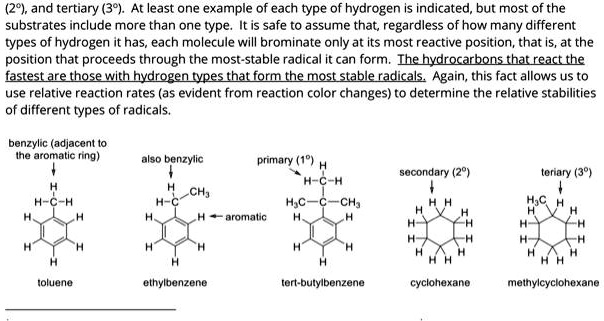
(2°), and tertiary (3°). At least one example of each type of hydrogen is indicated, but most of the substrates include more than one type. It is safe to assume that, regardless of how many different types of hydrogen it has, each molecule will brominate only at its most reactive position, that is, at the position that proceeds through the most-stable radical it can form. The hydrocarbons that react the fastest are those with hydrogen types that form the most stable radicals. Again, this fact allows us to use relative reaction rates (as evident from reaction color changes) to determine the relative stabilities of different types of radicals.
benzylic (adjacent to the aromatic ring)
also benzylic primary (1°) H secondary (2°) teriary (3°) H-C-H H-C-H H-C CH$_3$ H$_3$C-C-CH$_3$ H$_3$C H H H H H H H H H H H H H H H H H H H H H H H H H H H H H H H H H toluene ethylbenzene tert-butylbenzene cyclohexane methylcyclohexane