QUESTION 4
Exercise 9.27 (page 328) relates to the performance information on tire sidewalls.
Suppose the resesearchers wish to determine at the 0.05 level of significance, Is there evidence that the population mean tread wear index is less than 200?
Using the critical value approach, state statistical decision.
Since $t_{STAT}$ falls into the rejection region, we reject $H_0$
Since $Z_{STAT}$ falls into the rejection region, we reject $H_0$
Since $Z_{STAT}$ falls into the non-rejection region, we do not reject $H_0$
Since $t_{STAT}$ falls into the non-rejection region, we do not reject $H_0$
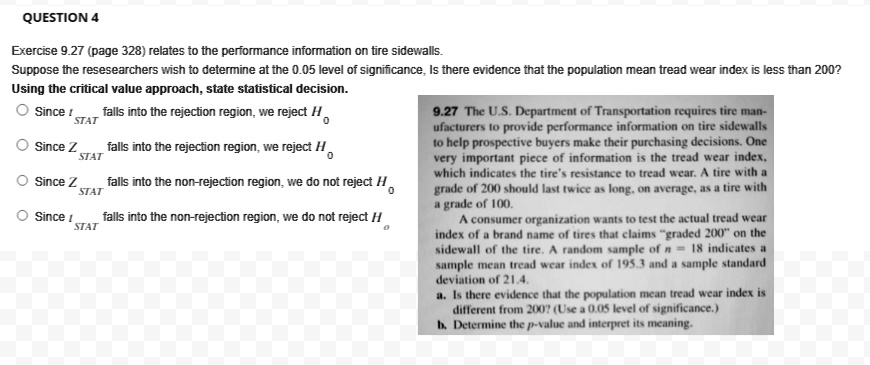
9.27 The U.S. Department of Transportation requires tire manufacturers to provide performance information on tire sidewalls
to help prospective buyers make their purchasing decisions. One
very important piece of information is the tread wear index,
which indicates the tire's resistance to tread wear. A tire with a
grade of 200 should last twice as long, on average, as a tire with
a grade of 100.
A consumer organization wants to test the actual tread wear
index of a brand name of tires that claims \"graded 200\" on the
sidewall of the tire. A random sample of $n = 18$ indicates a
sample mean tread wear index of 195.3 and a sample standard
deviation of 21.4.
a. Is there evidence that the population mean tread wear index is
different from 200? (Use a 0.05 level of significance.)
b. Determine the $p$-value and interpret its meaning.