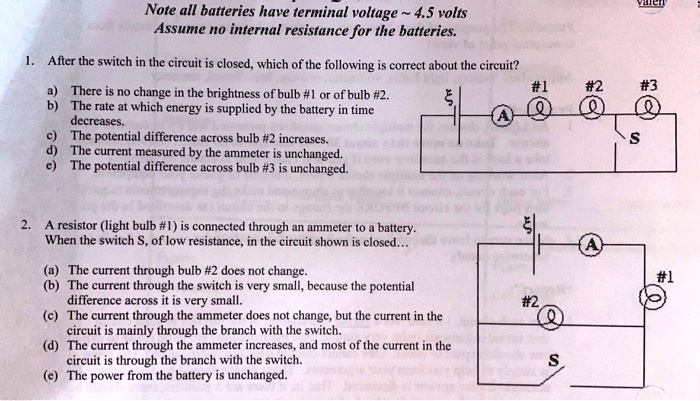
Note all batteries have terminal voltage ~ 4.5 volts
Assume no internal resistance for the batteries.
1. After the switch in the circuit is closed, which of the following is correct about the circuit?
a) There is no change in the brightness of bulb #1 or of bulb #2.
b) The rate at which energy is supplied by the battery in time
decreases.
c) The potential difference across bulb #2 increases.
d) The current measured by the ammeter is unchanged.
e) The potential difference across bulb #3 is unchanged.
2. A resistor (light bulb #1) is connected through an ammeter to a battery.
When the switch S, of low resistance, in the circuit shown is closed...
(a) The current through bulb #2 does not change.
(b) The current through the switch is very small, because the potential
difference across it is very small.
(c) The current through the ammeter does not change, but the current in the
circuit is mainly through the branch with the switch.
(d) The current through the ammeter increases, and most of the current in the
circuit is through the branch with the switch.
(e) The power from the battery is unchanged.