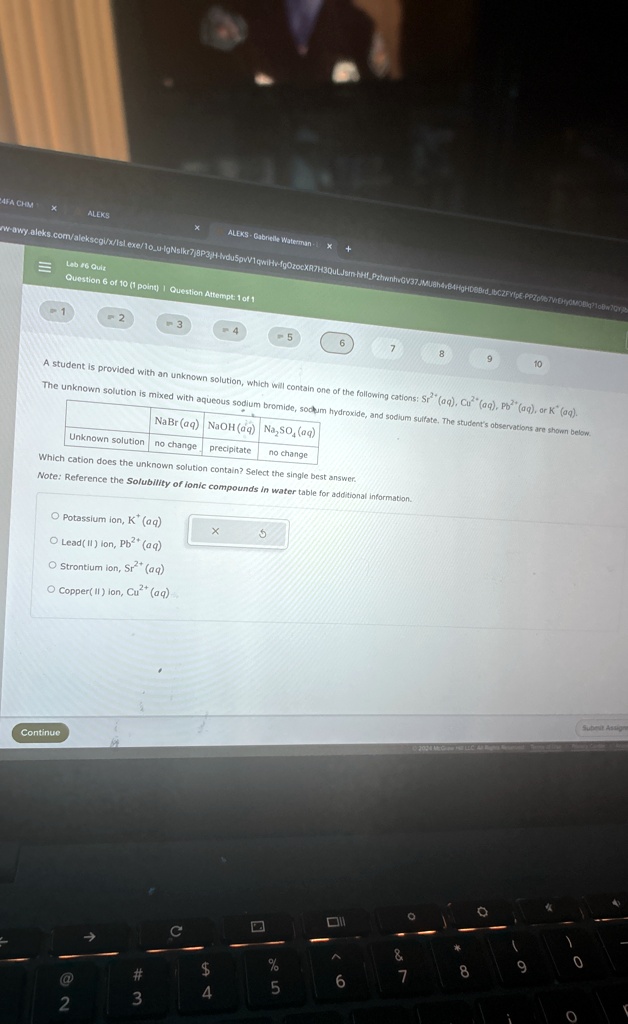
A student is provided with an unknown solution, which will contain one of the following cations: Sr$^{2+}$ (aq), Cu$^{2+}$ (aq), Pb$^{2+}$ (aq), or K$^{+}$ (aq).
The unknown solution is mixed with aqueous sodium bromide, sodium hydroxide, and sodium sulfate. The student's observations are shown below.
\begin{tabular}{|c|c|c|}
\hline
NaBr (aq) & NaOH (aq) & Na$_2$SO$_4$ (aq) \\
\hline
Unknown solution & no change & precipitate & no change \\
\hline
\end{tabular}
Which cation does the unknown solution contain? Select the single best answer.
Note: Reference the Solubility of ionic compounds in water table for additional information.
Potassium ion, K$^{+}$ (aq)
Lead(II) ion, Pb$^{2+}$ (aq)
Strontium ion, Sr$^{2+}$ (aq)
Copper(II) ion, Cu$^{2+}$ (aq)