Ace - AI Tutor
Ask Our Educators
Textbooks
My Library
Flashcards
Scribe - AI Notes
Notes & Exams
Download App
nicole berenguer

nicole b.

Divider

Questions asked

BEST MATCH

Draw the following waves, indicating for each how you proceeded in setting up the axes for each carrier wave and modulator wave: a. sine wave gated by square wave b. triangular wave amplitude modulated by a sine wave

View Answer
divider
BEST MATCH

Did the addition of acetylcholine solution hyperpolarize or depolarize the cardiac muscle plasma membrane?

View Answer
divider
BEST MATCH

(a) Let A and B be two events of a sample space S, show that P(A\cap B)>=P(A)+P(B)-1. (b) If A and B are independent events in a sample space S then show that A and B complement are also independent.

View Answer
divider
BEST MATCH

Fungi are characterized by cell walls that contain peptidoglycan membranes that contain cholesterol cell walls that contain chitin membranes that contain ergosterol

View Answer
divider
BEST MATCH

2. Consider the signals given below and answer the following questions: Signal 1: $x_1(t) = 2 rect(t/4)$ Signal 2: $x_2(t)$ is a periodic signal with fundamental period $T_0 = 7$ and one period given as follows: $$x_2(t) = \begin{cases} t, & 0 \le t < 2 \\ 0, & 2 \le t < 7 \end{cases}$$ (a) Calculate the average power and energy present in the two signals. (b) Classify these signals as power or energy signals.

View Answer
divider
BEST MATCH

According to the humanists, when people have a mission to fulfill in life or some problem outside of themselves to pursue, such as those pursued by Albert Schweitzer and Mother Teresa, they are exhibiting O an efficient perception of reality. O spontaneity. O task centering. O autonomy.

View Answer
divider
BEST MATCH

Mary Beard describes Rome as a consuming city, which means that Romans were entirely self-sufficient by making all that they consumed. Group of answer choices True False

View Answer
divider
BEST MATCH

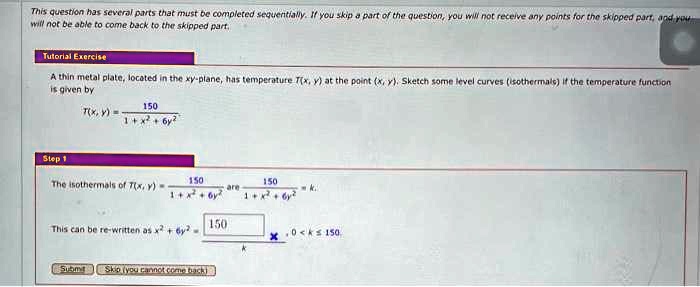
This question has several parts that must be completed sequentially. If you skip a part of the question, you will not receive any points for the skipped part, and you will not be able to come back to the skipped part. Tutorial Exercise A thin metal plate, located in the xy-plane, has temperature $T(x, y)$ at the point $(x, y)$. Sketch some level curves (isothermals) if the temperature function is given by $$T(x, y) = \frac{150}{1 + x^2 + 6y^2}$$ Step 1 The isothermals of $T(x, y) = \frac{150}{1 + x^2 + 6y^2}$ are $\frac{150}{1 + x^2 + 6y^2} = k$. This can be re-written as $x^2 + 6y^2 = \boxed{150}$ $0 < k \le 150$
View Answer
divider
BEST MATCH

Here, we consider the equivalence of the electric dipole and \"A\cdot p\" versions of the Hamiltonian for certain optical absorption processes. (i) Prove for a single-electron Hamiltonian of the form \begin{align*} \hat{H}_{el} = \frac{-\hbar^2}{2m_o}\nabla^2 + V(\mathbf{r}) \end{align*} that \begin{align*} [\hat{H}_{el}, \mathbf{r}] = -i\frac{\hbar}{m_o}\hat{\mathbf{p}} \end{align*} (ii) When $|\psi_1\rangle$ and $|\psi_2\rangle$ are eigenfunctions of $\hat{H}_{el}$, with corresponding eigenenergies $E_1$ and $E_2$, find an expression relating $P_{21} = \langle\psi_2|\hat{\mathbf{p}}|\psi_1\rangle$ to $r_{21} = \langle\psi_2|\mathbf{r}|\psi_1\rangle$. (iii) Consider the two possible time-dependent perturbing Hamiltonians \begin{align*} \hat{H}_{p4} = -\frac{e}{m_o}\mathbf{A}\cdot\hat{\mathbf{p}}, \text{ with } \mathbf{A} = \mathbf{A}_o \cos\omega t \end{align*} and \begin{align*} \hat{H}_{pe} = -e\mathbf{E}\cdot\mathbf{r}, \text{ with } \mathbf{E} = \mathbf{E}_o \cos\omega t \end{align*} Show that, in Fermi's Golden Rule, these two Hamiltonians lead to the same transition rate for the same strength of electromagnetic field for transitions between eigenstates of $\hat{H}_{el}$. (You may use the relation $\mathbf{E} = -\partial \mathbf{A}/\partial t$.)

View Answer
divider
BEST MATCH

Question 6 (1 point) Declare an array of type bool of length 5 with a name of Barray. Be sure to strike the Enter key before you click on the Save button. Save abs Question 7 (1 point) Given the following array declaration, how would you refer to the first element in the array? double b[4]; 1) b[1] 2) b[4] 3) b[0] 4) b[3] 5) b[2] Save

View Answer
divider