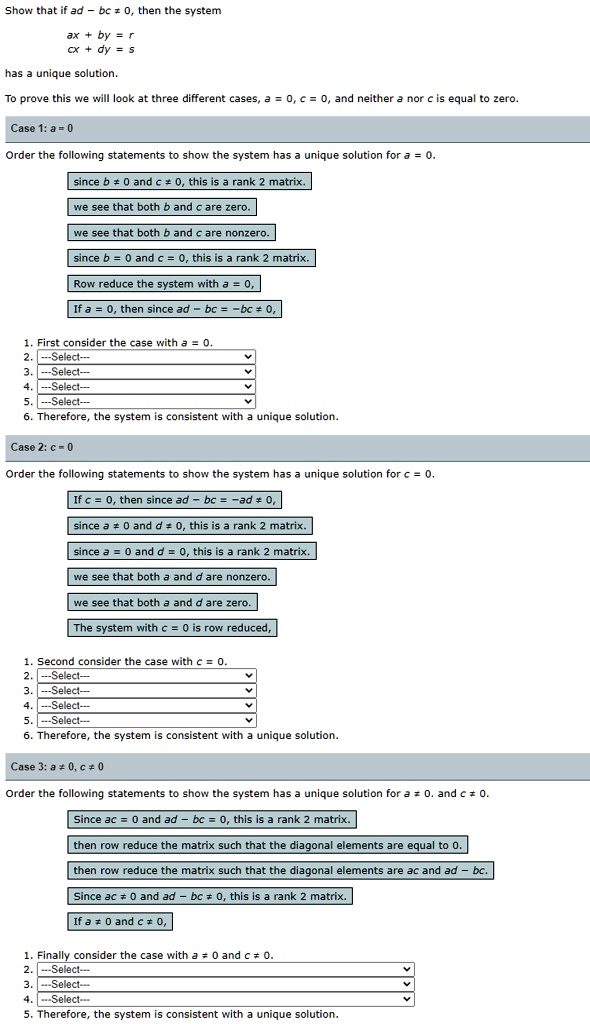
Text: Show that if d - bc ≠0, then the system
x + y = q
cx + dy = s
has a unique solution.
To prove this, we will look at three different cases: d = 0, c = 0, and neither a nor c is equal to zero.
Case 1: d = 0
Order the following statements to show that the system has a unique solution for d = 0.
1. Since b ≠0 and c ≠0, this is a rank 2 matrix.
2. We see that both b and c are nonzero.
3. We see that both b and c are zero.
4. Since b = 0 and c = 0, this is a rank 2 matrix.
Row reduce the system with d = 0.
If d = 0, then since ad - bc = -bc ≠0,
1. First, consider the case with d = 0.
2. Therefore, the system is consistent with a unique solution.
Case 2: c = 0
Order the following statements to show that the system has a unique solution for c = 0.
If c = 0, then since ad - bc = ad ≠0,
1. Since a ≠0 and d ≠0, this is a rank 2 matrix.
2. Since x = 0 and d = 0, this is a rank 2 matrix.
3. We see that both a and d are nonzero.
4. We see that both a and d are zero.
The system with c = 0 is row reduced.
1. Second, consider the case with c = 0.
2. Therefore, the system is consistent with a unique solution.
Case 3: a ≠0 and c ≠0
Order the following statements to show that the system has a unique solution for a ≠0 and c ≠0.
Since c ≠0 and ad - bc ≠0, this is a rank 2 matrix.
Then row reduce the matrix such that the diagonal elements are equal to 0.
Then row reduce the matrix such that the diagonal elements are ac and ad - bc.
Since ac ≠0 and ad - bc ≠0, this is a rank 2 matrix.
If a ≠0 and c ≠0,
1. Finally, consider the case with a ≠0 and c ≠0.
2. Therefore, the system is consistent with a unique solution.