10. [0/10 Points]
DETAILS
PREVIOUS ANSWERS
DEVORESTAT9 2.5.081.
MY NOTES
ASK YOUR TEACHER
PRACTICE ANOTHER
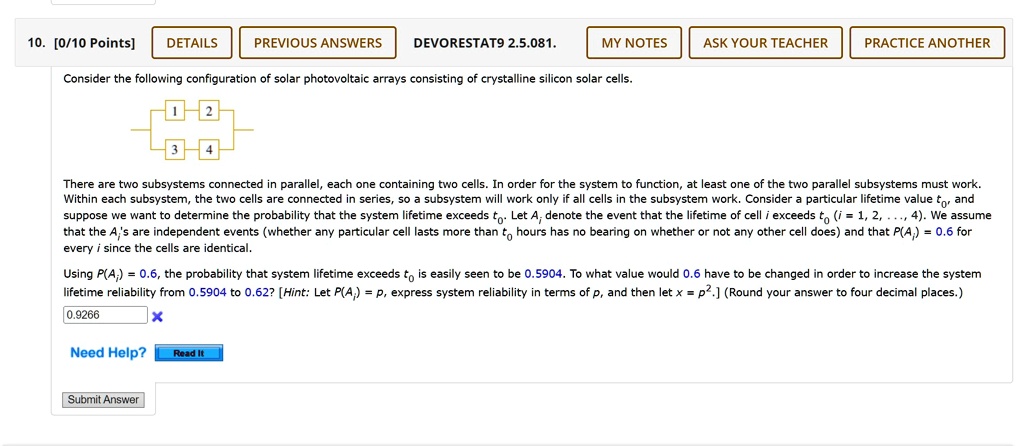
Consider the following configuration of solar photovoltaic arrays consisting of crystalline silicon solar cells.
There are two subsystems connected in parallel, each one containing two cells. In order for the system to function, at least one of the two parallel subsystems must work.
Within each subsystem, the two cells are connected in series, so a subsystem will work only if all cells in the subsystem work. Consider a particular lifetime value $t_0$, and
suppose we want to determine the probability that the system lifetime exceeds $t_0$. Let $A_i$ denote the event that the lifetime of cell $i$ exceeds $t_0$ ($i = 1, 2, \dots, 4$). We assume
that the $A_i$'s are independent events (whether any particular cell lasts more than $t_0$ hours has no bearing on whether or not any other cell does) and that $P(A_i) = 0.6$ for
every $i$ since the cells are identical.
Using $P(A_i) = 0.6$, the probability that system lifetime exceeds $t_0$ is easily seen to be 0.5904. To what value would 0.6 have to be changed in order to increase the system
lifetime reliability from 0.5904 to 0.62? [Hint: Let $P(A_i) = p$, express system reliability in terms of $p$, and then let $x = p^2$.] (Round your answer to four decimal places.)
0.9266
X
Need Help?
Read It
Submit Answer