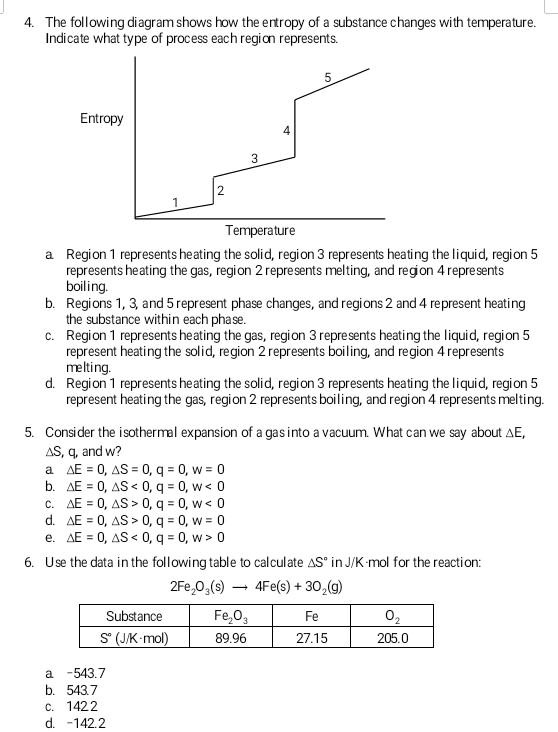
4. The following diagram shows how the entropy of a substance changes with temperature.
Indicate what type of process each region represents.
Entropy
4
3
2
1
5
Temperature
a Region 1 represents heating the solid, region 3 represents heating the liquid, region 5
represents heating the gas, region 2 represents melting, and region 4 represents
boiling.
b. Regions 1, 3, and 5 represent phase changes, and regions 2 and 4 represent heating
the substance within each phase.
c. Region 1 represents heating the gas, region 3 represents heating the liquid, region 5
represent heating the solid, region 2 represents boiling, and region 4 represents
melting.
d. Region 1 represents heating the solid, region 3 represents heating the liquid, region 5
represent heating the gas, region 2 represents boiling, and region 4 represents melting.
5. Consider the isothermal expansion of a gas into a vacuum. What can we say about ?E,
?S, q, and w?
a ?E = 0, ?S = 0, q = 0, w = 0
b. ?E = 0, ?S < 0, q = 0, w < 0
c. ?E = 0, ?S > 0, q = 0, w < 0
d. ?E = 0, ?S > 0, q = 0, w = 0
e. ?E = 0, ?S < 0, q = 0, w > 0
6. Use the data in the following table to calculate ?S° in J/K-mol for the reaction:
2Fe$_2$O$_3$(s) $\rightarrow$ 4Fe(s) + 3O$_2$(g)
Substance
S° (J/K-mol)
Fe$_2$O$_3$
89.96
Fe
O$_2$
27.15
205.0
a -543.7
b. 543.7
c. 1422
d. -142.2