PHYS 214
Laboratory
Thin Lenses
PHYS 214
Exploration
1: Determining the Focal Length of a Convex Lens
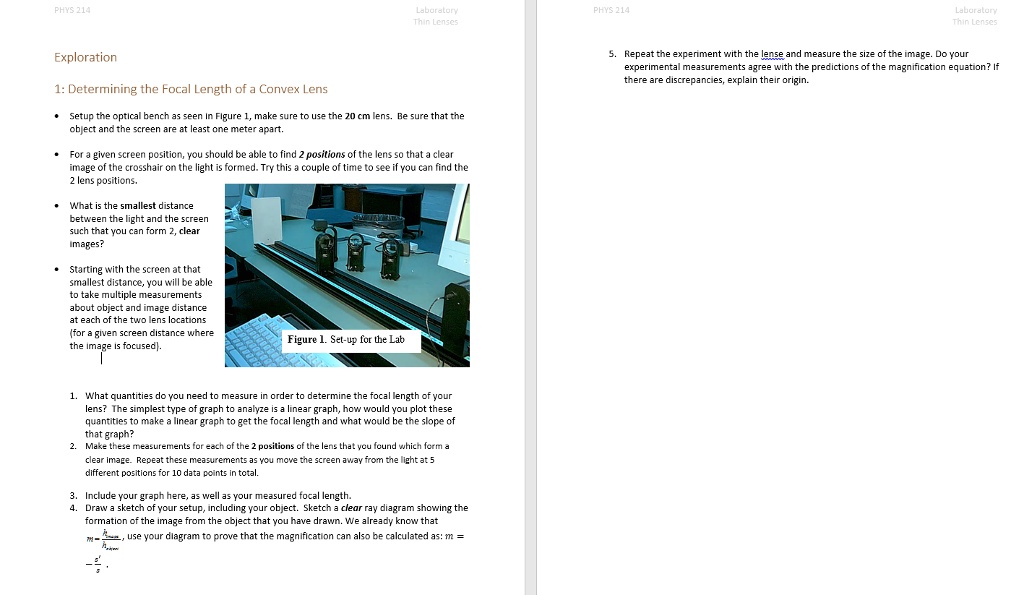
• Setup the optical bench as seen in Figure 1, make sure to use the 20 cm lens. Be sure that the
object and the screen are at least one meter apart.
• For a given screen position, you should be able to find 2 positions of the lens so that a clear
image of the crosshair on the light is formed. Try this a couple of time to see if you can find the
2 lens positions.
• What is the smallest distance
between the light and the screen
such that you can form 2, clear
images?
• Starting with the screen at that
smallest distance, you will be able
to take multiple measurements
about object and image distance
at each of the two lens locations
(for a given screen distance where
the image is focused).
Figure 1. Set-up for the Lab
1. What quantities do you need to measure in order to determine the focal length of your
lens? The simplest type of graph to analyze is a linear graph, how would you plot these
quantities to make a linear graph to get the focal length and what would be the slope of
that graph?
2. Make these measurements for each of the 2 positions of the lens that you found which form a
clear image. Repeat these measurements as you move the screen away from the light at 5
different positions for 10 data points in total.
3. Include your graph here, as well as your measured focal length.
4. Draw a sketch of your setup, including your object. Sketch a clear ray diagram showing the
formation of the image from the object that you have drawn. We already know that
$ \frac{h_i}{h_o} = \frac{-s_i}{s_o} $, use your diagram to prove that the magnification can also be calculated as: m =
Laboratory
Thin Lenses
5. Repeat the experiment with the lense and measure the size of the image. Do your
experimental measurements agree with the predictions of the magnification equation? If
there are discrepancies, explain their origin.