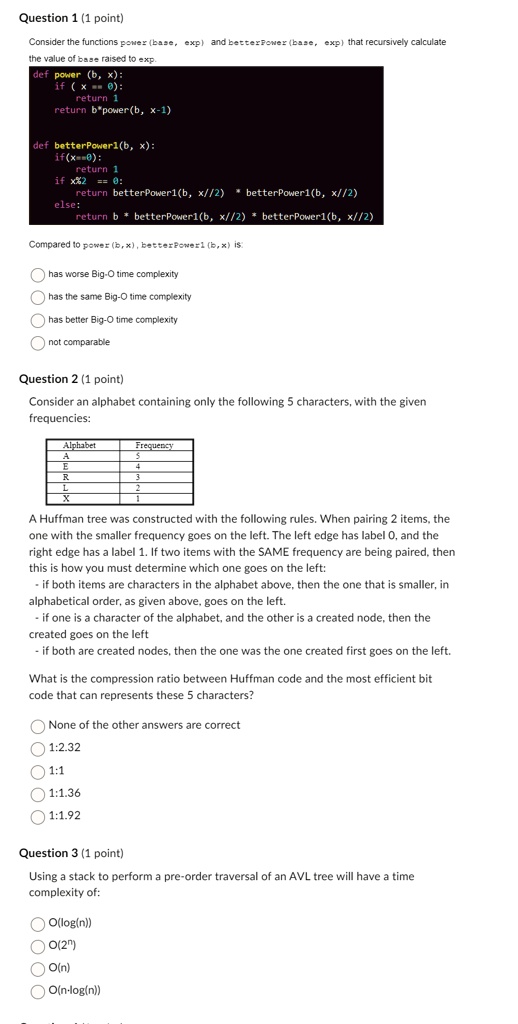
Question 1 (1 point)
Consider the functions power (base, exp) and betterPower (base, exp) that recursively calculate
the value of base raised to exp.
def power (b, x):
if (x == 0):
return 1
return b*power(b, x-1)
def betterPower1(b, x):
if(x==0):
return 1
if x%2 == 0:
return betterPower1(b, x//2) * betterPower1(b, x//2)
else:
return b * betterPower1(b, x//2) * betterPower1(b, x//2)
Compared to power (b,x), betterPowerl (b,x) is:
has worse Big-O time complexity
has the same Big-O time complexity
has better Big-O time complexity
not comparable
Question 2 (1 point)
Consider an alphabet containing only the following 5 characters, with the given
frequencies:
Alphabet Frequency
A 5
E 4
R 3
L 2
X 1
A Huffman tree was constructed with the following rules. When pairing 2 items, the
one with the smaller frequency goes on the left. The left edge has label 0, and the
right edge has a label 1. If two items with the SAME frequency are being paired, then
this is how you must determine which one goes on the left:
- if both items are characters in the alphabet above, then the one that is smaller, in
alphabetical order, as given above, goes on the left.
- if one is a character of the alphabet, and the other is a created node, then the
created goes on the left
- if both are created nodes, then the one was the one created first goes on the left.
What is the compression ratio between Huffman code and the most efficient bit
code that can represents these 5 characters?
None of the other answers are correct
1:2.32
1:1
1:1.36
1:1.92
Question 3 (1 point)
Using a stack to perform a pre-order traversal of an AVL tree will have a time
complexity of:
O(log(n))
O(2^n)
O(n)
O(n-log(n))