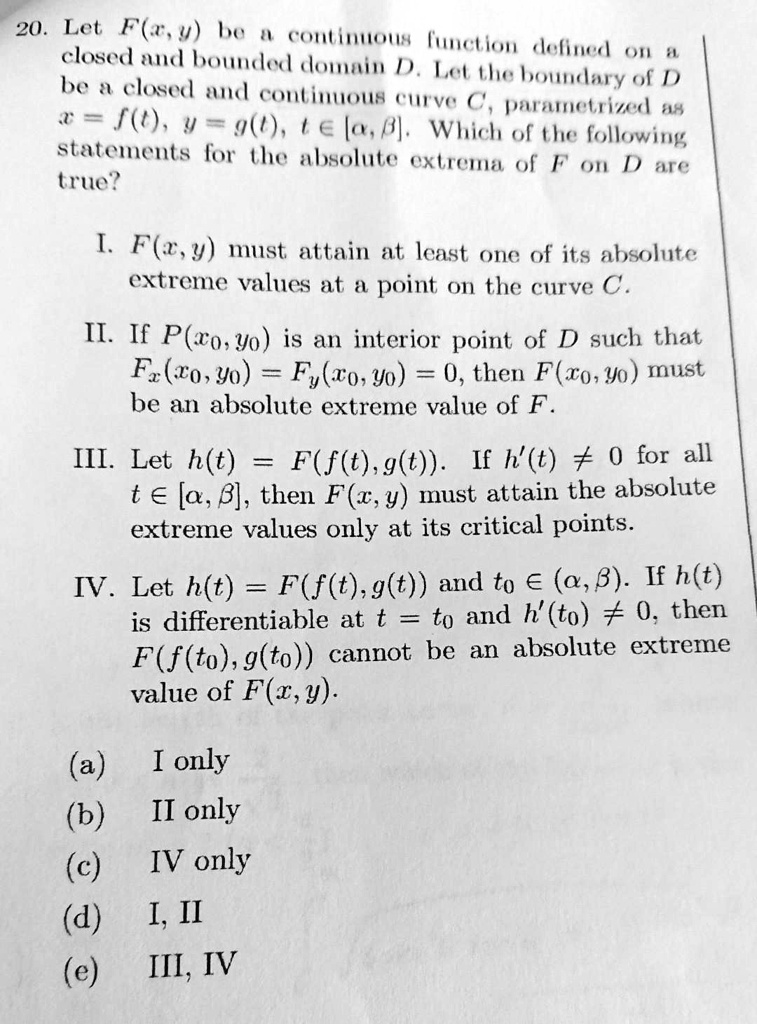
20. Let $F(x, y)$ be a continuous function defined on a
closed and bounded domain D. Let the boundary of D
be a closed and continuous curve C, parametrized as
x = f(t), y = g(t), t ? [?, ?]. Which of the following
statements for the absolute extrema of F on D are
true?
I. F(x, y) must attain at least one of its absolute
extreme values at a point on the curve C.
II. If P($x_0$, $y_0$) is an interior point of D such that
$F_x$($x_0$, $y_0$) = $F_y$($x_0$, $y_0$) = 0, then F($x_0$, $y_0$) must
be an absolute extreme value of F.
III. Let h(t) = F(f(t), g(t)). If h'(t) ? 0 for all
t ? [?, ?], then F(x, y) must attain the absolute
extreme values only at its critical points.
IV. Let h(t) = F(f(t), g(t)) and $t_0$ ? (?, ?). If h(t)
is differentiable at t = $t_0$ and h'($t_0$) ? 0, then
F(f($t_0$), g($t_0$)) cannot be an absolute extreme
value of F(x, y).
(a) I only
(b) II only
(c) IV only
(d) I, II
(e) III, IV