Ace - AI Tutor
Ask Our Educators
Textbooks
My Library
Flashcards
Scribe - AI Notes
Notes & Exams
Download App
nina parker

nina p.

Divider

Questions asked

BEST MATCH

bead pairs separate from one another. These bead pairs represent the genotypes of 50 Rehpogs you are studying. This is the Ancestral Population as in Part I. 3) Record this first randomly generated Ancestral Population: number of (RR) pairs, (Rr) pairs and (rr) pairs. The frequency of the (R) and (r) alleles is 50 each in this Ancestral Population. *Take a photo for submission 4) A cataclysmic genetic drift event splits the Ancestral Population into two equal groups! Divide your 50 original pairs into two sets of 25 pairs. Do this randomly separating all three genotypes between the two groups. *Take a photo for submission 5) New selective pressure: Group A is now confined to a steep rocky area, while Group B lives on relatively flat, but uneven ground. Gene flow between the two groups is impossible. 6) Do not resort the beads! Record the number of homozygous dominant (RR), heterozygous (Rr) and homozygous recessive (rr) pairs of beads in Group A and in Group B on the charts below. These are Generation A1 and Generation B1. 7) POPULATION A: Homozygous dominant individuals have a genetic predisposition towards wandering off cliffs. RR genotypes have a higher chance of not surviving and reproducing in the next generation in their new environment. Remove 50% of the Blue/Blue bead pairs in Group A . Remember to round up or down to an even number of allele pairs if 50% is an uneven number of pairs. Put the Group A beads back in your cup and mix them together. Without looking in the cup, randomly pull out pairs of beads until the cup is empty. This is Group A Generation 2. Record the allele distribution, then remove 50% of the RR (Blue/Blue) bead pairs and continue the process to complete the chart for Group A. 8) POPULATION B: Homozygous dominant individuals in Population B also have a genetic predisposition towards wandering off cliffs, but there are few cliffs in the new Group B environment. Remove only 10% of the Blue/Blue pairs in Group B in every generation. This may result in your removing only one pair or no pairs of RR (Blue/Blue) allele pairs per generation. Put the Group B beads back in your cup and mix them together. Without looking in the cup, randomly pull out pairs of beads until the cup is empty. This is Group B Generation 2. Record the allele distribution, then remove 10% of the RR (Blue/Blue) bead pairs and continue the process to complete the chart for Group B. Blue/Blue = RR genotype (homozygous dominant) phenotype = thick purple fur Blue/Pink = Rr genotype (heterozygous) phenotype = thick purple fur Pink/Pink = rr genotype (homozygous recessive

View Answer
divider
BEST MATCH

How can becoming more culturally competent impact the services you deliver with your clients?

View Answer
divider
BEST MATCH

Practice of spending 112 over a variety of different financial investments in order to reduce overall risk is that

View Answer
divider
BEST MATCH

Consider fluid flow over a flat plate (2 m length) and the fluid has a bulk stream velocity of $u_\infty$= 15/ms. At T = 300 K, what is the fluid's velocity component, in the x-direction, at the wall surface? a. 0.5 $u_\infty$ b. 0 c. $u_\infty$ d. 0.99 $u_\infty$

View Answer
divider
BEST MATCH

What happens to the effectiveness of a conditioned reinforcer as the frequency of unconditioned reinforcement increases? It becomes less effective. It decreases over time. It increases to a maximum level. It has no impact on effectiveness.

View Answer
divider
BEST MATCH

Question 75 Question 75 1 Point The ________ coding scheme contains a set of 128 numeric codes that are used to represent characters in the computer's memory. ASCII ENIAC Unicode two's complement

View Answer
divider
BEST MATCH

k. \( \lim _{x \rightarrow 0} \frac{1-\cos 2 x}{2 \sin ^{2} x+2 x \tan 3 x} \)

View Answer
divider
BEST MATCH

The legal system is an example of: social capital. physical capital. human capital. entrepreneurial capital.

View Answer
divider
BEST MATCH

Library/ASU-topics/setFunctions/di7.pg The domain of the function $f(x) = \frac{\sqrt{16 + x}}{2 - x}$ is $[-16,2) \cup (2,\infty)$ Note: Write your answer in interval notation. If the answer includes more than one interval write the intervals se If the answer involves $-\infty$, input -infinity; if the answer involves $\infty$, input infinity.

View Answer
divider
BEST MATCH

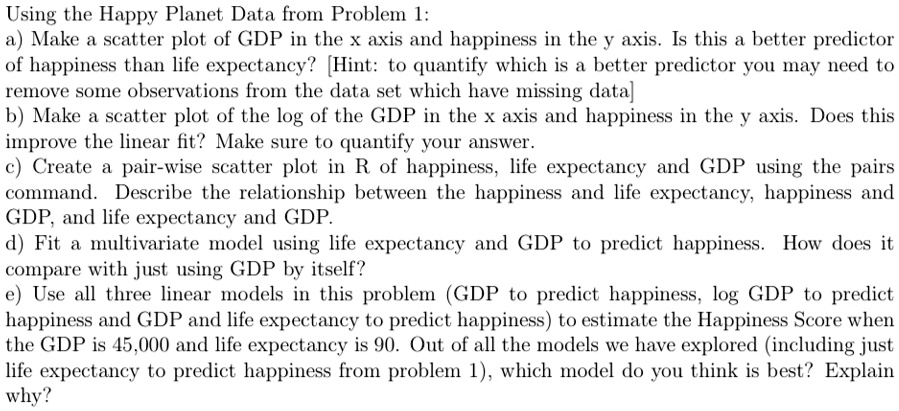
Using the Happy Planet Data from Problem 1: a) Make a scatter plot of GDP in the x axis and happiness in the y axis. Is this a better predictor of happiness than life expectancy? [Hint: to quantify which is a better predictor you may need to remove some observations from the data set which have missing data] b) Make a scatter plot of the log of the GDP in the x axis and happiness in the y axis. Does this improve the linear fit? Make sure to quantify your answer. c) Create a pair-wise scatter plot in R of happiness, life expectancy and GDP using the pairs command. Describe the relationship between the happiness and life expectancy, happiness and GDP, and life expectancy and GDP. d) Fit a multivariate model using life expectancy and GDP to predict happiness. How does it compare with just using GDP by itself? e) Use all three linear models in this problem (GDP to predict happiness, log GDP to predict happiness and GDP and life expectancy to predict happiness) to estimate the Happiness Score when the GDP is 45,000 and life expectancy is 90 . Out of all the models we have explored (including just life expectancy to predict happiness from problem 1), which model do you think is best? Explain why? Using the Happy Planet Data from Problem 1 a Make a scatter plot of GDP in the x axis and happiness in the y axis. Is this a better predicto of happiness than life expectancy? [Hint: to quantify which is a better predictor you may need to remove some observations from the data set which have missing data] b) Make a scatter plot of the log of the GDP in the x axis and happiness in the y axis. Does this improve the linear fit? Make sure to quantify your answer. c) Create a pair-wise scatter plot in R of happiness, life expectancy and GDP using the pairs command. Describe the relationship between the happiness and life expectancy, happiness and GDP, and life expectancy and GDP. d) Fit a multivariate model using life expectancy and GDP to predict happiness. How does it compare with just using GDP by itself? e Use all three linear models in this problem (GDP to predict happiness, log GDP to predict happiness and GDP and life expectancy to predict happiness) to estimate the Happiness Score when the GDP is 45.000 and life expectancy is 90. Out of all the models we have explored (including just life expectancy to predict happiness from problem 1), which model do you think is best? Explain why?
View Answer
divider