Ace - AI Tutor
Ask Our Educators
Textbooks
My Library
Flashcards
Scribe - AI Notes
Notes & Exams
Download App
norman falc-n

norman f.

Divider

Questions asked

BEST MATCH

Multiple-choice question. What is the major product of this reaction? $$H_3CO$$ $$H_2SO_4, HNO_3$$ Product a) $$H_3CO$$ $$NO_2$$ b) $$H_3CO$$ $$NO_2$$ c) $$H_3CO$$ $$NO_2$$ d) $$H_3CO$$ $$NO_2$$

View Answer
divider
BEST MATCH

The__________ show(s) a remarkable degree of degeneration (involution) with age. Question 40 options: 1) lymph nodes 2) thymus 3) spleen 4) pharyngeal tonsils 5) appendix

View Answer
divider
BEST MATCH

fact or myth: long-term storage of C in soil is in the form of microbial biomass

View Answer
divider
BEST MATCH

What can you do to elute a compound that is not coming off the column

View Answer
divider
BEST MATCH

Optional Bonus Problem 1 (Points: 1) Consider a state with a very short lifetime of 100 fs. Determine the natural linewidth broadening due to this finite lifetime. Give your answer in frequency and wavenumber. Optional Bonus Problem 2 (Points: 2) A methane (CH$_4$) molecule has C-H bond length of 108.7 pm and H-C-H bond angle of 109.5°. Which kind of a rotor is methane? How many unique moment of inertia does methane have? Determine the rotational constant for each unique moment of inertia for methane. Give your answer in wavenumbers. Optional Bonus Problem 3 (Points: 1) Acetone, (CH$_3$)$_2$CO, the molecule shown in Figure 1 has the following absorbance bands, obtained in infrared and ultraviolet-visible spectroscopy: 1. Strong absorbance at 1793 cm$^{-1}$ in the infrared spectrum. 2. Strong absorbance at 189 nm in the ultraviolet-visible spectrum. 3. Weak absorbance at 280 nm in the ultraviolet-visible spectrum. Assign each of the absorbance bands to a specific transition and to a specific group in the molecule.

View Answer
divider
BEST MATCH

Since the end of World War II, the yearly incidence of any type of armed conflict has Group of answer choices decreased dramatically increased steadily, reaching an all-time high in 1992, then declined slightly remained the same increased at a constant rate decreased at a constant rate

View Answer
divider
BEST MATCH

The term "RNA world" describes the possibility that self-replicating RNA Multiple choice question. was the only organic molecule present for millions of years on early Earth. may have been present in multiple forms, forming a pre-life community of molecules. formed the membranes that eventually enclosed molecules and gave rise to cells.

View Answer
divider
BEST MATCH

7. Determine each of the following differential equations is linear or not. (a) \frac{d^2y}{dx^2} + 5\frac{dy}{dx} + 6y^2 = 0 (b) \frac{d^2y}{dx^2} + 5(\frac{dy}{dx})^3 + 6y = 0 (c) \frac{d^2y}{dx^2} + 5x^2\frac{dy}{dx} + 6y = 0 (d) \frac{d^2y}{dx^2} + 5y\frac{dy}{dx} + 6y = 0 (e) \frac{d^2y}{dx^2} + 5x\frac{dy}{dx} + e^x = 0 8. Solve the following differential equations: (a) Separable equation: \frac{dy}{dx} = y^2e^{-x} \frac{dy}{dx} = \frac{y+1}{xy^2}, \quad y(3e^2) = 2 (b) Homogeneous equation: \frac{dy}{dx} = \frac{x - y}{x + y} \frac{dy}{dx} = \frac{y^2}{x^2 + x} (c) Nearly homogeneous equation: \frac{dy}{dx} = \frac{2x - 5y - 9}{-4x + y + 9} \frac{dy}{dx} = \frac{3x + y - 1}{6x + 2y - 3} (d) Exact equation: (e^xsin(y) - 2x)dx + (e^xcos(y) + 1)dy = 0 (4y^4 + 3cos(x))dx + (16y^3x - 3cos(y))dy = 0

View Answer
divider
BEST MATCH

For the given network, please use the variables on your answer sheet and get R1 = 10 \cdot var1 k\Omega, R2 = 10 \cdot var2 k\Omega, R3 = 100 \cdot var4 k\Omega, R4 = 100 \cdot var2 k\Omega, R5 = 10 \cdot var1 k\Omega, R6 = 100 \cdot var3 k\Omega, R7 = 10 \cdot var2 k\Omega, R8 = 10 \cdot var1 k\Omega, R9 = 10 \cdot var1 M\Omega V1 = 10 \cdot var11 mV, V2 = 10 \cdot -var12 mV, V3 = 100 \cdot -var1 mV V_{CC} = 10 \cdot var12 V, V_{EE} = 10 \cdot -var12 V Please find Vout and give answer in as V, do not include anything else than the answer and format will be 5.01e+7 or 1.02e-1.
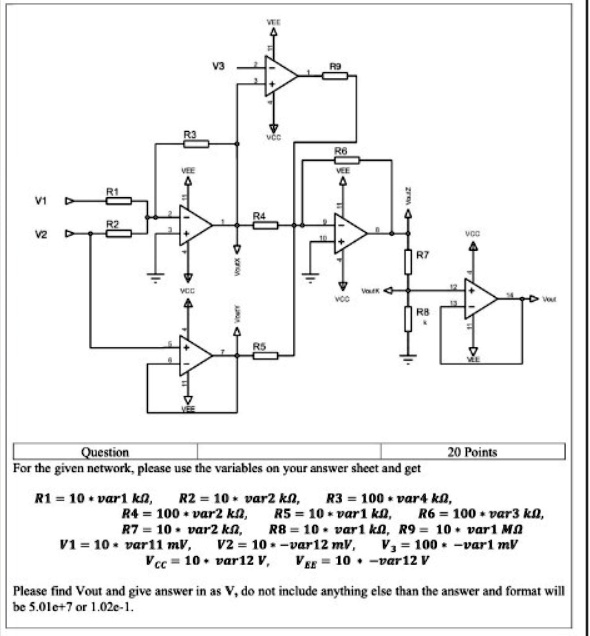
View Answer
divider
BEST MATCH

I would like to see work to understand In a 4-sample system with X(s) = 4/(s+7), the Laplace transform is X(s) = 4(e^(-s/4)-1) 0.25e^(-7/4) (e^(-s/4)-1) 0.8e^(5/5) (e^(5/5) - 1)^2 c/ e^(a/5) 4e^(-4) (e^(-4)-e^(7/4)) None of the above

View Answer
divider