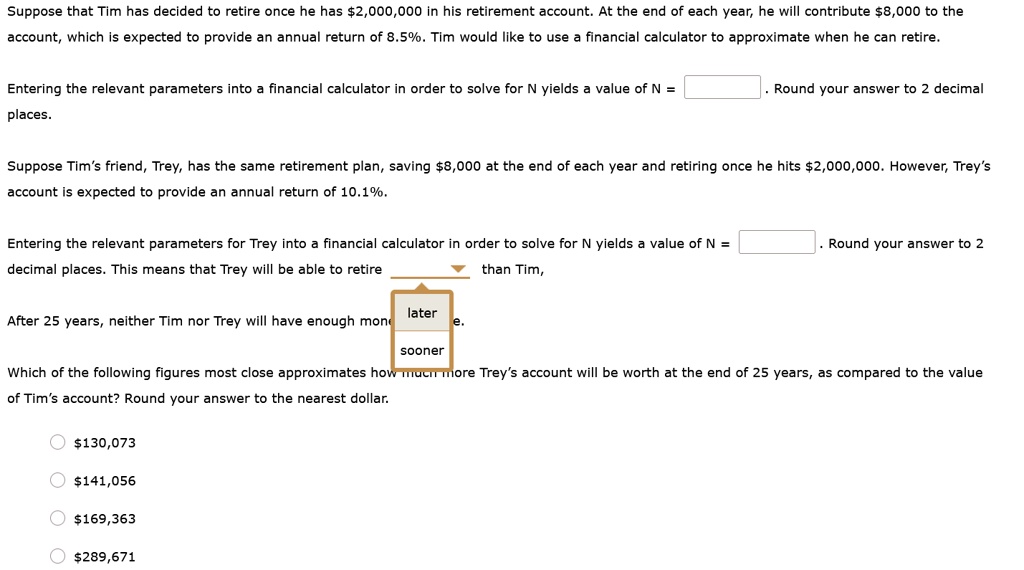
Suppose that Tim has decided to retire once he has $2,000,000 in his retirement account. At the end of each year, he will contribute $8,000 to the account, which is expected to provide an annual return of 8.5%. Tim would like to use a financial calculator to approximate when he can retire.
Entering the relevant parameters into a financial calculator in order to solve for N yields a value of N = . Round your answer to 2 decimal places.
Suppose Tim's friend, Trey, has the same retirement plan, saving $8,000 at the end of each year and retiring once he hits $2,000,000. However, Trey's account is expected to provide an annual return of 10.1%.
Entering the relevant parameters for Trey into a financial calculator in order to solve for N yields a value of N = . Round your answer to 2 decimal places. This means that Trey will be able to retire than Tim,
After 25 years, neither Tim nor Trey will have enough money to retire.
Which of the following figures most close approximates how much more Trey's account will be worth at the end of 25 years, as compared to the value of Tim's account? Round your answer to the nearest dollar.
$130,073
$141,056
$169,363
$289,671