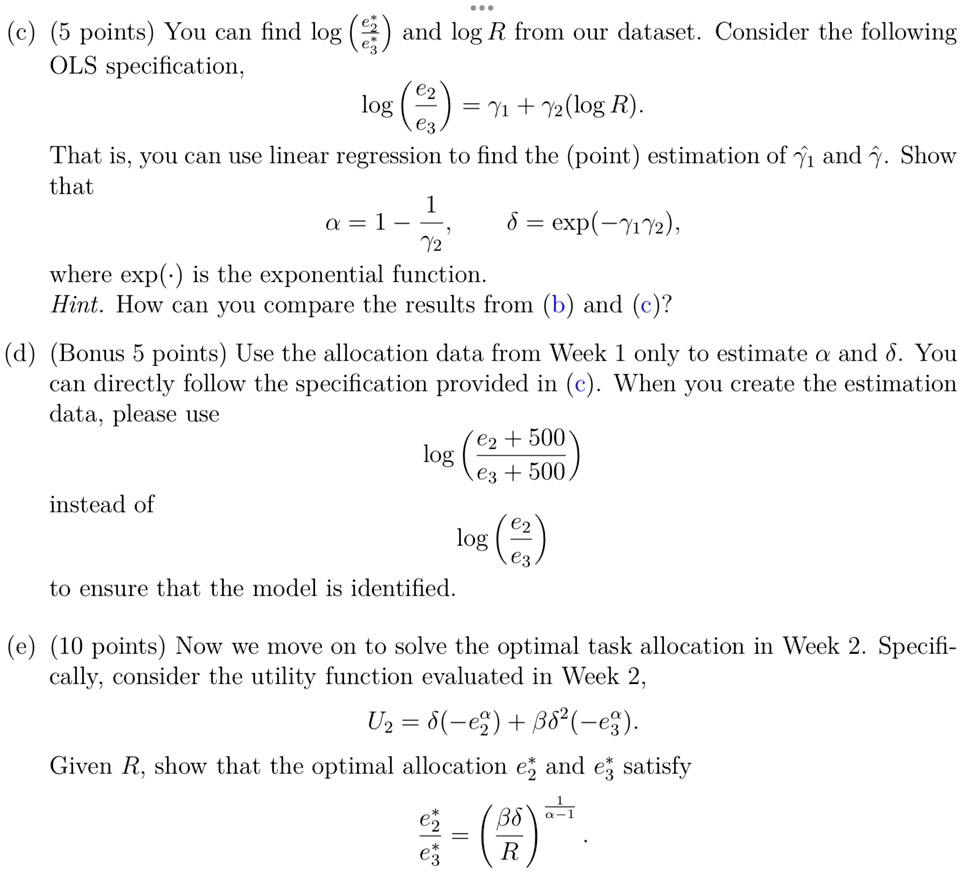
(c) (5 points) You can find $\log\left(\frac{e_2}{e_3}\right)$ and $\log R$ from our dataset. Consider the following OLS specification,
$\log\left(\frac{e_2}{e_3}\right) = \gamma_1 + \gamma_2(\log R)$.
That is, you can use linear regression to find the (point) estimation of $\gamma_1$ and $\gamma_2$. Show that
$\alpha = 1 - \frac{1}{\gamma_2}$, $\delta = \exp(-\gamma_1/\gamma_2)$,
where $\exp(\cdot)$ is the exponential function.
Hint. How can you compare the results from (b) and (c)?
(d) (Bonus 5 points) Use the allocation data from Week 1 only to estimate $\alpha$ and $\delta$. You can directly follow the specification provided in (c). When you create the estimation data, please use
$\log\left(\frac{e_2 + 500}{e_3 + 500}\right)$
instead of
$\log\left(\frac{e_2}{e_3}\right)$
to ensure that the model is identified.
(e) (10 points) Now we move on to solve the optimal task allocation in Week 2. Specifically, consider the utility function evaluated in Week 2,
$U_2 = \delta(-e_2^*) + \beta\delta^2(-e_3^*)$.
Given R, show that the optimal allocation $e_2^*$ and $e_3^*$ satisfy
$\frac{e_2^*}{e_3^*} = \left(\frac{\beta\delta}{R}\right)^{\frac{1}{\alpha-1}}$.