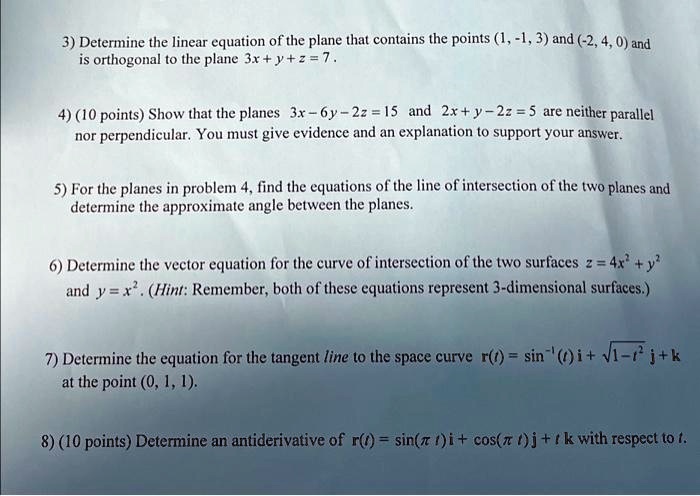
3) Determine the linear equation of the plane that contains the points (1, -1, 3) and (-2, 4, 0) and
is orthogonal to the plane $3x + y + z = 7$.
4) (10 points) Show that the planes $3x - 6y - 2z = 15$ and $2x + y - 2z = 5$ are neither parallel
nor perpendicular. You must give evidence and an explanation to support your answer.
5) For the planes in problem 4, find the equations of the line of intersection of the two planes and
determine the approximate angle between the planes.
6) Determine the vector equation for the curve of intersection of the two surfaces $z = 4x^2 + y^2$
and $y = x^2$. (Hint: Remember, both of these equations represent 3-dimensional surfaces.)
7) Determine the equation for the tangent line to the space curve $r(t) = \sin^{-1}(t)i + \sqrt{1 - t^2}j + k$
at the point (0, 1, 1).
8) (10 points) Determine an antiderivative of $r(t) = \sin(\pi t)i + \cos(\pi t)j + tk$ with respect to $t$.