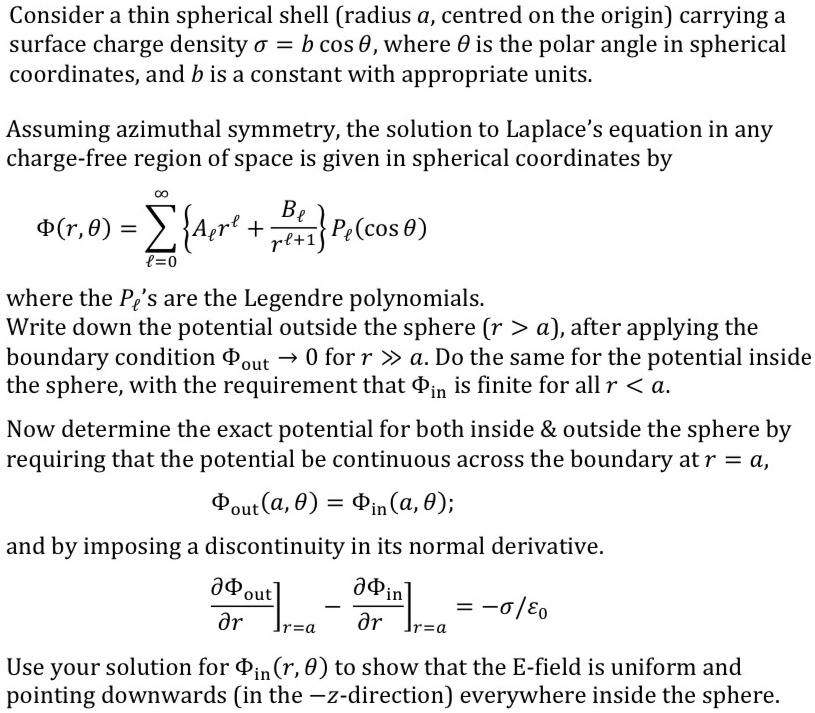
Consider a thin spherical shell (radius a, centred on the origin) carrying a
surface charge density \(\sigma = b \cos \theta\), where \(\theta\) is the polar angle in spherical
coordinates, and b is a constant with appropriate units.
Assuming azimuthal symmetry, the solution to Laplace's equation in any
charge-free region of space is given in spherical coordinates by
\(\infty
\Phi(r, \theta) = \sum_{l=0} \left\{ A_l r^l + \frac{B_l}{r^{l+1}} \right\} P_l(\cos \theta)
where the \(P_l\)'s are the Legendre polynomials.
Write down the potential outside the sphere \((r > a)\), after applying the
boundary condition \(\Phi_{out} \to 0\) for \(r >> a\). Do the same for the potential inside
the sphere, with the requirement that \(\Phi_{in}\) is finite for all \(r < a\).
Now determine the exact potential for both inside & outside the sphere by
requiring that the potential be continuous across the boundary at \(r = a\),
\(\Phi_{out}(a, \theta) = \Phi_{in}(a, \theta);\
and by imposing a discontinuity in its normal derivative.
\(\left. \frac{\partial \Phi_{out}}{\partial r} \right|_{r=a} - \left. \frac{\partial \Phi_{in}}{\partial r} \right|_{r=a} = -\sigma/\epsilon_0
Use your solution for \(\Phi_{in}(r, \theta)\) to show that the E-field is uniform and
pointing downwards (in the -z-direction) everywhere inside the sphere.