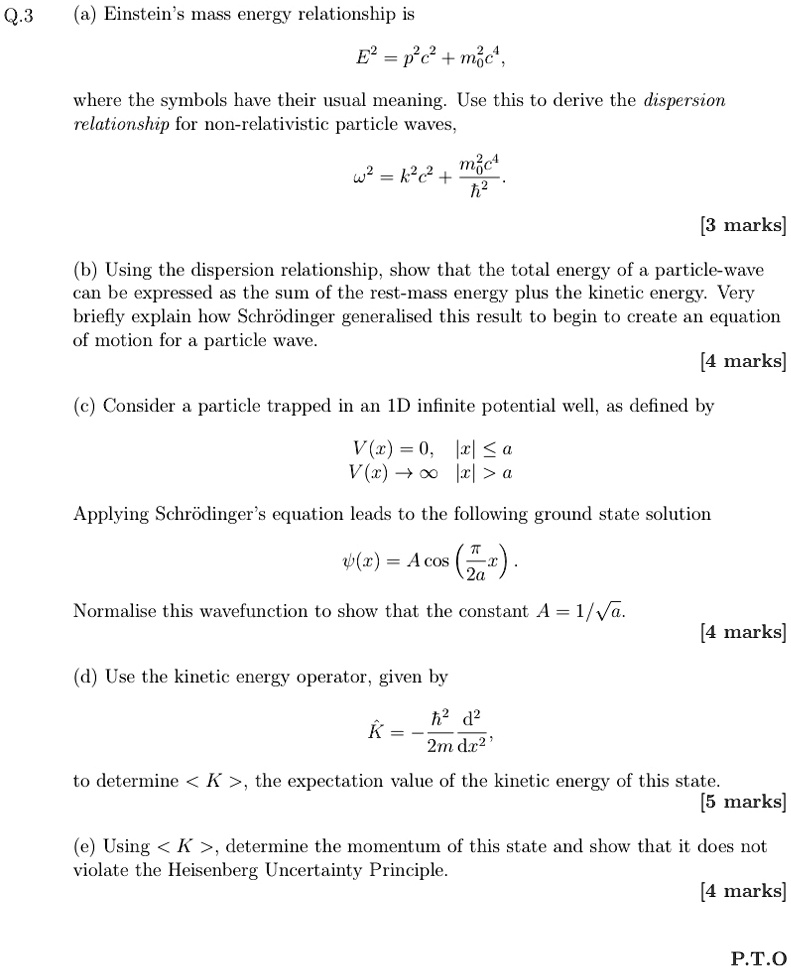
(a) Einstein's mass energy relationship is
$E^2 = p^2c^2 + m_0^2c^4$,
where the symbols have their usual meaning. Use this to derive the dispersion
relationship for non-relativistic particle waves,
$\omega^2 = k^2c^2 + \frac{m_0^2c^4}{\hbar^2}$.
(b) Using the dispersion relationship, show that the total energy of a particle-wave
can be expressed as the sum of the rest-mass energy plus the kinetic energy. Very
briefly explain how Schrödinger generalised this result to begin to create an equation
of motion for a particle wave.
(c) Consider a particle trapped in an 1D infinite potential well, as defined by
$V(x) = 0$, $|x| \le a$
$V(x) \to \infty$ $|x| > a$
Applying Schrödinger's equation leads to the following ground state solution
$\psi(x) = A \cos\left(\frac{\pi x}{2a}\right)$.
Normalise this wavefunction to show that the constant $A = 1/\sqrt{a}$.
(d) Use the kinetic energy operator, given by
$\hat{K} = -\frac{\hbar^2}{2m}\frac{d^2}{dx^2}$,
to determine $<K>$, the expectation value of the kinetic energy of this state.
(e) Using $<K>$, determine the momentum of this state and show that it does not
violate the Heisenberg Uncertainty Principle.