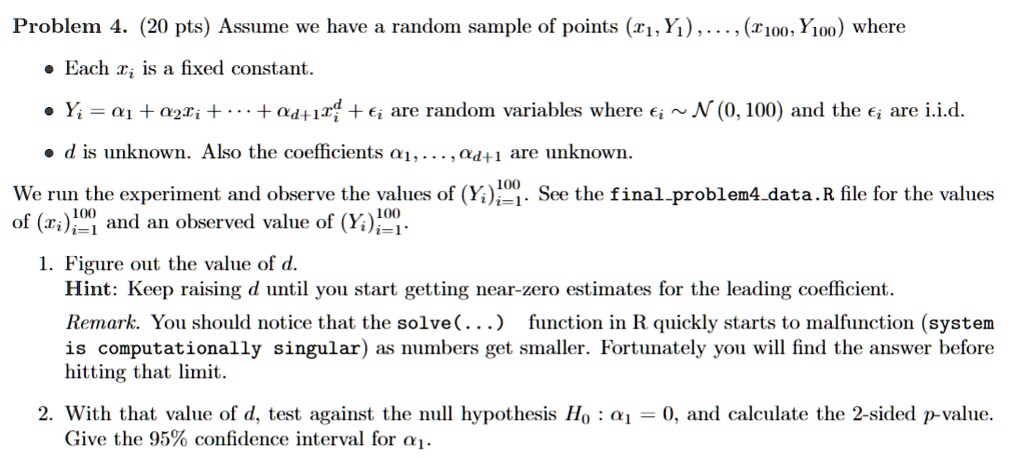
Problem 4. (20 pts) Assume we have a random sample of points (x_(1),Y_(1)),dots,(x_(100),Y_(100)) where
Each x_(i) is a fixed constant.
Y_(i)=alpha _(1)+alpha _(2)x_(i)+cdots+alpha _(d+1)x_(i)^(d)+epsi lon_(i) are random variables where epsi lon_(i)∼N(0,100) and the epsi lon_(i) are i.i.d.
d is unknown. Also the coefficients alpha _(1),dots,alpha _(d+1) are unknown.
We run the experiment and observe the values of (Y_(i))_(i)=1^(100). See the final_problem4_data. R file for the values
of (x_(i))_(i)=1^(100) and an observed value of (Y_(i))_(i)=1^(100).
Figure out the value of d.
Hint: Keep raising d until you start getting near-zero estimates for the leading coefficient.
Remark. You should notice that the solve(...) function in R quickly starts to malfunction (system
is computationally singular) as numbers get smaller. Fortunately you will find the answer before
hitting that limit.
With that value of d, test against the null hypothesis H_(0):alpha _(1)=0, and calculate the 2 -sided p-value.
Give the 95% confidence interval for alpha _(1).
Problem 4. (20 pts) Assume we have a random sample of points (1, Yi),...,(10o,Yioo) where
. Each ; is a fixed constant.
Y; = 1 + 2; + ... + d+1 + ; are random variables where ; ~ N (0,100) and the ; are i.i.d.
. d is unknown. Also the coefficients 1,...,d+1 are unknown.
1. Figure out the value of d. Hint: Keep raising d until you start getting near-zero estimates for the leading coefficient.
Remark. You should notice that the solve(..) function in R quickly starts to malfunction (system is computationally singular) as numbers get smaller. Fortunately you will find the answer before hitting that limit.
2. With that value of d, test against the null hypothesis Ho : = 0, and calculate the 2-sided p-value. Give the 95% confidence interval for 1.