Saved
Help
Save \& Exit
1
Check my
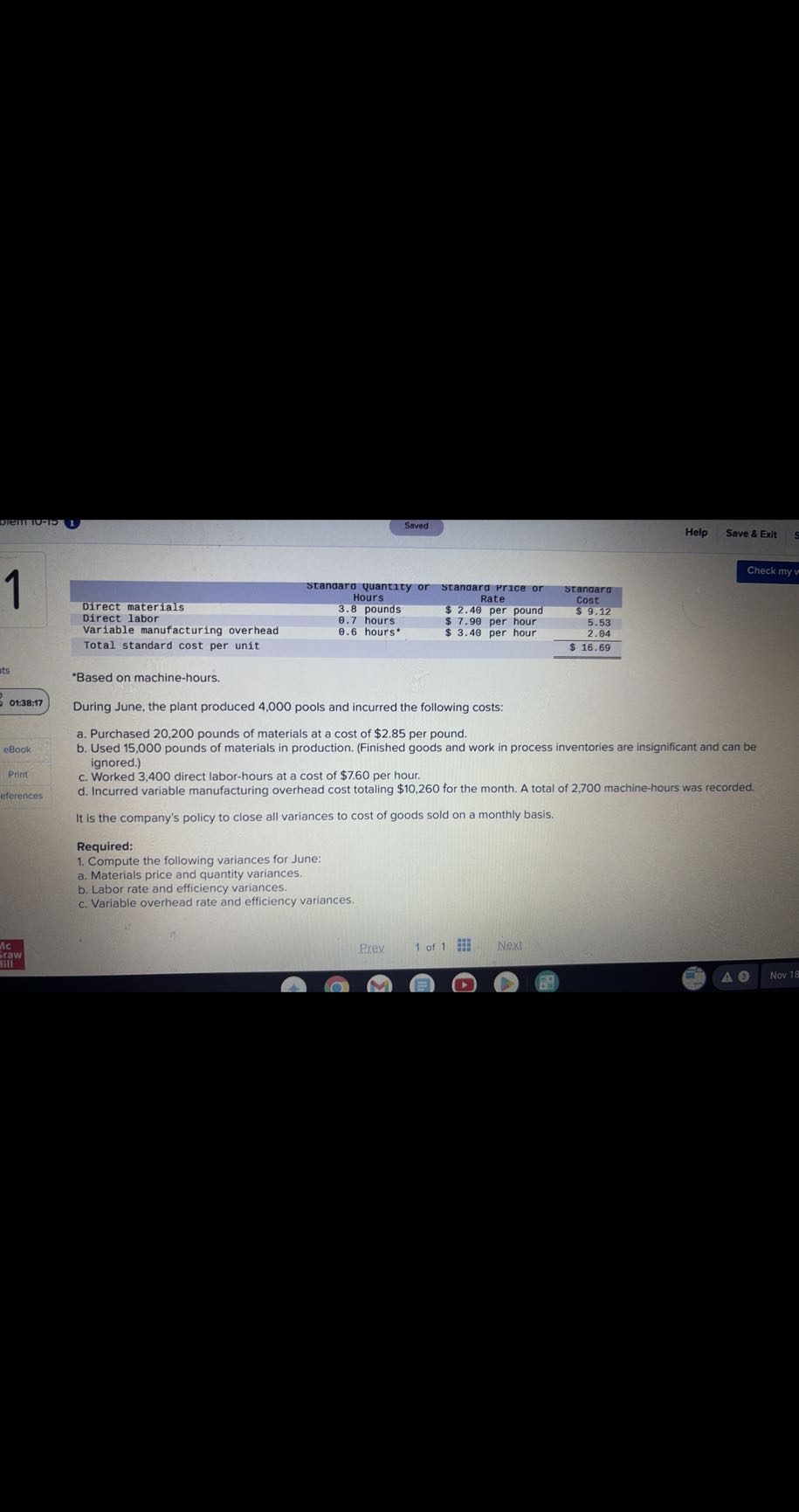
\begin{tabular}{|c|c|c|c|c|c|c|c|c|c|}
\hline & \multicolumn{2}{|l|}{standara Quantity or Hours} & \multicolumn{4}{|l|}{stangara price or Rate} & \multicolumn{3}{|l|}{\begin{tabular}{l}
standara \\
Cost
\end{tabular}} \\
\hline Direct materials & 3.8 & pounds & \$ & 2.40 & per & pound & & & \\
\hline Direct labor & 0.7 & hours & \$ & 7.90 & per & & & & 5.53 \\
\hline Variable manufacturing overhead & 0.6 & hours* & \$ & 3.40 & per & hour & & & 2.04 \\
\hline Total standard cost per unit & & & & & & & & & 6.69 \\
\hline
\end{tabular}
ts
\( 01: 38: 17 \)
"Based on machine-hours.
During June, the plant produced 4,000 pools and incurred the following costs:
a. Purchased 20,200 pounds of materials at a cost of \( \$ 2.85 \) per pound.
b. Used 15,000 pounds of materials in production. (Finished goods and work in process inventories are insignificant and can be ignored.)
c. Worked 3,400 direct labor-hours at a cost of \( \$ 7.60 \) per hour.
d. Incurred variable manufacturing overhead cost totaling \( \$ 10,260 \) for the month. A total of 2,700 machine-hours was recorded.
It is the company's policy to close all variances to cost of goods sold on a monthly basis.
Required:
1. Compute the following variances for June:
a. Materials price and quantity variances.
b. Labor rate and efficiency variances.
c. Variable overhead rate and efficiency variances.
Rrex
1 of 1 \#
Next