Consider each tape to be a rigid body with all its mass and net charge at its center. This is an oversimplification, but a useful model for approximating an order-of-magnitude estimate of displaced charge. Keep in mind that Figure 7-1 is a diagram of the experiment, not an FBD. However, it includes all the information needed to create one.
PROCEDURE
(1) Draw an FBD for one piece of tape in this experiment, and include this in your report. If you are having difficulty, please see Helpful Hints.
(2) Using your FBD, derive an expression for tan(θ) in terms of Fcoulomb and Fgravity, where θ is half of the angle between the two pieces of tape at the apex of the tent shape, and r/2 is the length of the side of a right triangle opposite angle θ. (See Helpful Hints if this is challenging.)
(3) Solve this expression for the mutual repulsive Coulomb force, Fcoulomb, due to like charges. This will give you a mathematical model, an equation, for Fcoulomb in terms of r, L, and Fgravity.
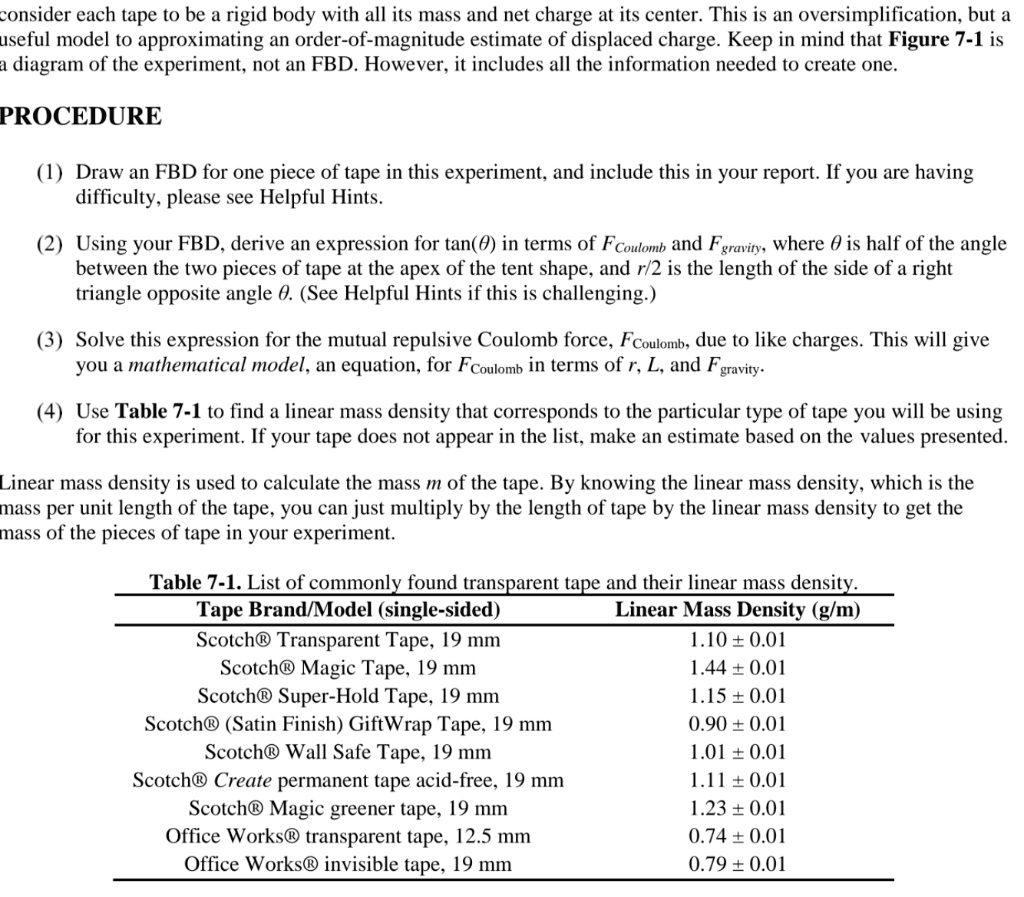
(4) Use Table 7-1 to find a linear mass density that corresponds to the particular type of tape you will be using for this experiment. If your tape does not appear in the list, make an estimate based on the values presented.
Linear mass density is used to calculate the mass m of the tape. By knowing the linear mass density, which is the mass per unit length, you can determine the mass of the pieces of tape in your experiment.
Table 7-1. List of commonly found transparent tape and their linear mass density.
Tape Brand/Model (single-sided) Linear Mass Density (g/m)
Scotch Transparent Tape, 19 mm 1.10 ± 0.01
Scotch Magic Tape, 19 mm 1.44 ± 0.01
Scotch Super-Hold Tape, 19 mm 1.15 ± 0.01
Scotch (Satin Finish) GiftWrap Tape, 19 mm 0.90 ± 0.01
Scotch Wall Safe Tape, 19 mm 1.01 ± 0.01
Scotch Create permanent tape acid-free, 19 mm 1.11 ± 0.01
Scotch Magic greener tape, 19 mm 1.23 ± 0.01
Office Works transparent tape, 12.5 mm 0.74 ± 0.01
Office Works invisible tape, 19 mm 0.79 ± 0.01