Ace - AI Tutor
Ask Our Educators
Textbooks
My Library
Flashcards
Scribe - AI Notes
Notes & Exams
Download App
Onkabetse Nkawana

Onkabetse N.

Divider

Viewed Questions

Find the indicated $Z$ -score. Be sure to draw a standard normal curve that depicts the solution.
Find the $Z$ -scores that separate the middle $70 \%$ of the distribution from the area in the tails of the standard normal distribution.

Find the indicated $Z$ -score. Be sure to draw a standard normal curve that depicts the solution. Find the $Z$ -scores that separate the middle $70 \%$ of the distribution from the area in the tails of the standard normal distribution.

Fundamentals of Statistics

The Normal Probability Distribution

The Standard Normal Distribution

Let $X$ be $N(5,10)$. Find $P\left[0.04<(X-5)^{2}<38.4\right]$.

Let $X$ be $N(5,10)$. Find $P\left[0.04<(X-5)^{2}<38.4\right]$.

Introduction to Mathematical Statistics

Some Special Distributions

The Normal Distribution

Let $S^{2}$ be the variance of a random sample of size 6 from the normal distribution $n(\mu, 12) .$ Find $\operatorname{Pr}\left(2.30<S^{2}<22.2\right)$.

Introduction to Mathematical Statistics

Distributions of Functions of Random…

The Distributions of $X$ and $n S^{2} /…

The distribution of the scores on a certain exam is $N(80,5)$ which means that the exam scores are Normally distributed with a mean of 80 and a standard deviation of 5 .
a. Sketch or use technology to create the curve and label on the $x$ -axis the position of the mean, the mean plus or minus one standard deviation, the mean plus or minus two standard deviations, and the mean plus or minus three standard deviations.
b. Find the probability that a randomly selected score will be greater than
90. Shade the region under the Normal curve whose area corresponds to this probability.

The distribution of the scores on a certain exam is $N(80,5)$ which means that the exam scores are Normally distributed with a mean of 80 and a standard deviation of 5 . a. Sketch or use technology to create the curve and label on the $x$ -axis the position of the mean, the mean plus or minus one standard deviation, the mean plus or minus two standard deviations, and the mean plus or minus three standard deviations. b. Find the probability that a randomly selected score will be greater than 90. Shade the region under the Normal curve whose area corresponds to this probability.

Essential Statistics: Exploring the World through Data

Questions asked

INSTANT ANSWER

Diagonalize the matrix of row 1: 1 -3 3 row2: 3 -5 3 row3: 6 -6 4

View Answer
divider
ANSWERED

Kirsty Gledhill verified

Numerade educator

8. If ar{X} is the sample mean and S^2 is the sample variance for a random sample taken from a N ~ (100, sigma^2) population. (a) State the distribution of frac{ar{X}-100}{s/2} for a random sample of size 5. (b) What is the probability that the value in (a) above will exceed 1.533? 9. Let X_1, X_2, X_3, X_4, X_5 be a random sample of size 5 taken from a normally distributed population with mean 100 and standard deviation 25. Calculate the probability that the sample mean, ar{X}, will be between 80 and 120 10. A balanced die is tossed 120 times, find the probability that the face 6 will turn up not less than 16 times and not more than 23 times. 11. A boy flips a fair coin 100 independent times and a girl flips a fair coin 100 independent times. What is the probability that the boy will have 25 more heads than the girl?

View Answer
divider
ANSWERED

Robin Corrigan verified

Numerade educator

A normal distribution has mean 74 find the standard deviation if 9.68 of the total area under the curve lies to the right of 100

View Answer
divider
INSTANT ANSWER

2. If \( X \sim N\left(\mu, \sigma^{2}\right) \), find \( b \) so that \( P\left(-b<\frac{X-\mu}{\sigma}<b\right)=0.90 \) 3. Let \( X \sim N\left(\mu, \sigma^{2}\right) \) so that \( P(X<89)=0.90 \) and \( P(X<94)=0.95 \). Find \( \mu \) and \( \sigma^{2} \) 4. Let \( X_{1}, X_{2}, \ldots, X_{n} \) be a random sample of size \( n=6 \) from \( N(\mu, 12) \). Let \( \bar{X}=\frac{1}{n} \sum_{i=1}^{n} X_{i} \) be the mean of the sample and \( S^{2}=\frac{1}{n} \sum_{i=1}^{n}\left(X_{i}-\bar{X}\right)^{2} \) be the variance of the sample. Find \[ P\left(2.30<S^{2}<22.2\right) \] 5. Let \( X \sim N(5,10) \). Find \[ P\left(0.04<(X-5)^{2}<38.4\right) \] 6. Let \( X_{1}, X_{2}, \ldots, X_{25} \) and \( Y_{1}, Y_{2}, \ldots, Y_{25} \) be two independent random samples from two normal distributions \( N(0,16) \) and \( N(1,9) \), respectively. Let \( \bar{X} \) and \( \bar{Y} \) denote the corresponding sample means. Compute \( P(\bar{X}>\bar{Y}) \) 7. Let \( X_{1}, X_{2}, \ldots, X_{n} \) be a random sample of size \( n \) from a \( N\left(\mu, \sigma^{2}\right) \). Find the mean and variance of \[ S^{2}=\frac{1}{n} \sum\left(X_{i}-\bar{X}\right)^{2} . \] Hint: Find the mean and variance of \( \frac{n S^{2}}{\sigma^{2}} \).

View Answer
divider
INSTANT ANSWER

2. If \( X \sim N\left(\mu, \sigma^{2}\right) \), find \( b \) so that \( P\left(-b<\frac{X-\mu}{\sigma}<b\right)=0.90 \) 3. Let \( X \sim N\left(\mu, \sigma^{2}\right) \) so that \( P(X<89)=0.90 \) and \( P(X<94)=0.95 \). Find \( \mu \) and \( \sigma^{2} \) 4. Let \( X_{1}, X_{2}, \ldots, X_{n} \) be a random sample of size \( n=6 \) from \( N(\mu, 12) \). Let \( \bar{X}=\frac{1}{n} \sum_{i=1}^{n} X_{i} \) be the mean of the sample and \( S^{2}=\frac{1}{n} \sum_{i=1}^{n}\left(X_{i}-\bar{X}\right)^{2} \) be the variance of the sample. Find \[ P\left(2.30<S^{2}<22.2\right) \] 5. Let \( X \sim N(5,10) \). Find \[ P\left(0.04<(X-5)^{2}<38.4\right) \] 6. Let \( X_{1}, X_{2}, \ldots, X_{25} \) and \( Y_{1}, Y_{2}, \ldots, Y_{25} \) be two independent random samples from two normal distributions \( N(0,16) \) and \( N(1,9) \), respectively. Let \( \bar{X} \) and \( \bar{Y} \) denote the corresponding sample means. Compute \( P(\bar{X}>\bar{Y}) \) 7. Let \( X_{1}, X_{2}, \ldots, X_{n} \) be a random sample of size \( n \) from a \( N\left(\mu, \sigma^{2}\right) \). Find the mean and variance of \[ S^{2}=\frac{1}{n} \sum\left(X_{i}-\bar{X}\right)^{2} . \] Hint: Find the mean and variance of \( \frac{n S^{2}}{\sigma^{2}} \).

View Answer
divider
ANSWERED

Jon Southam verified

Numerade educator

1. Let X1, X2, ..., Xn be a random sample from a distribution that is N(?, ?²). Let X? be the mean of the sample and let S² be the variance of the sample. Find the mean and variance of S² 2. Let X denote the number of successes in a series of n independent Bernoulli trials with constant probability of success ?. If k * (X/n) * (1 - X/n) / n is an unbiased estimator of ?(1-?) / n what is the value of k?

View Answer
divider
INSTANT ANSWER

1. Let Let \( X_{1}, X_{2}, \ldots, X_{n} \) be a random sample from a distribution that is \( N\left(\mu, \sigma^{2}\right) \). Let \( \bar{X} \) be the mean of the sample and let \( S^{2} \) be the variance of the sample. Find the mean and variance of \( S^{2} \) [13 marks] 2. Let \( X \) denote the number of successes in a series of \( n \) independent Bernoulli trials with constant probability of success \( \theta \). If \[ k \frac{X}{n} \frac{\left(1-\frac{X}{n}\right)}{n} \] is an unbiased estimator of \[ \frac{\theta(1-\theta)}{n} \] what is the value of \( k \) ? [12 marks]

View Answer
divider
ANSWERED

Jacob Fry verified

Numerade educator

Show that E(T)= 1/ lambda Show that Var(T)= 1/ lambda squared

View Answer
divider
INSTANT ANSWER

6. Approximate the following integrals by both Trapezoidal rule and Simpson's rule with the specified number of subintervals and find the error bounds for both methods. (a) \( \int_{0}^{\frac{\pi}{4}} \cos 2 x d x, n=6 \) (b) \( \int_{1}^{2} \sqrt{1-\frac{1}{x}} d x, n=6 \) (c) \( \int_{-1}^{1} e^{-x^{2}} d x, n=4 \). (d) \( \int_{0}^{1}\left(1+x^{3}\right)^{\frac{1}{3}} d x, n=4 \). 7. Estimate the minimum number of subintervals needed to approximate the integrals with the error of magnitude less that \( 10^{-4} \) by (i) Trapezoidal Rule and (ii) Simpson's Rule. (a) \( \int_{1}^{2} \frac{1}{s^{2}} d s \); (b) \( \int_{0}^{3} \sqrt{x+1} d x \). 8. Use Riemann sums and the identities \[ \sum_{i=1}^{n} i^{3}=\frac{n^{2}(n+1)^{2}}{4}, \sum_{i=1}^{n} i^{2}=\frac{n(n+1)(2 n+1)}{6}, \sum_{i=1}^{n} i=\frac{n(n+1)}{2} \text { and } \sum_{i=1}^{n} c=n c \] to evaluate the following (i) \( \int_{2}^{4}(4 x-3) d x \) (ii) \( \int_{1}^{3}\left(6 x^{2}+4 x+3\right) d x \) (iii) \( \int_{-1}^{0} x(x+1)(x-1) d x \)

View Answer
divider
ANSWERED

Carson Merrill verified

Numerade educator

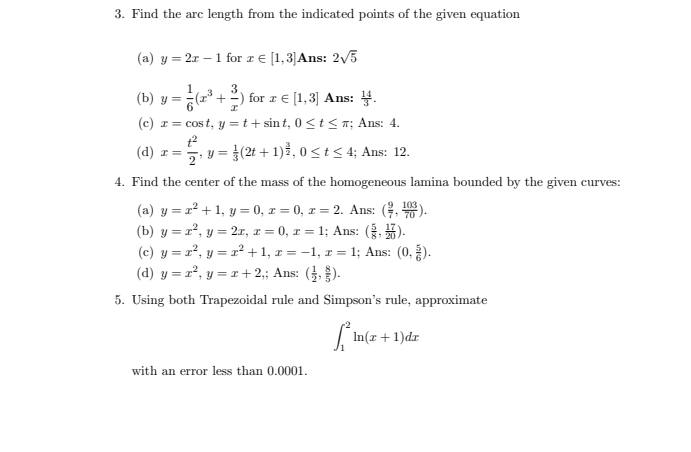
3. Find the arc length from the indicated points of the given equation (a) ( y=2 x-1 ) for ( x in[1,3] ) Ans: ( 2 sqrt{5} ) (b) ( y=frac{1}{6}left(x^{3}+frac{3}{x} ight) ) for ( x in[1,3] ) Ans: ( frac{14}{3} ). (c) ( x=cos t, y=t+sin t, 0 leq t leq pi ); Ans: 4 . (d) ( x=frac{t^{2}}{2}, y=frac{1}{3}(2 t+1)^{frac{3}{2}}, 0 leq t leq 4 ); Ans: 12 . 4. Find the center of the mass of the homogeneous lamina bounded by the given curves: (a) ( y=x^{2}+1, y=0, x=0, x=2 ). Ans: ( left(frac{9}{7}, frac{103}{70} ight) ). (b) ( y=x^{2}, y=2 x, x=0, x=1 ); Ans: ( left(frac{5}{8}, frac{17}{20} ight) ). (c) ( y=x^{2}, y=x^{2}+1, x=-1, x=1 ); Ans: ( left(0, frac{5}{6} ight) ). (d) ( y=x^{2}, y=x+2 ), ; Ans: ( left(frac{1}{2}, frac{8}{5} ight) ). 5. Using both Trapezoidal rule and Simpson's rule, approximate [ int_{1}^{2} ln (x+1) d x ] with an error less than ( 0.0001 ).
View Answer
divider