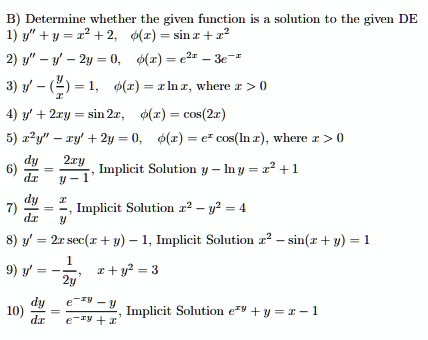
B) Determine whether the given function is a solution to the given DE
y^('')+y=x^(2)+2,phi (x)=sinx+x^(2)
y^('')-y^(')-2y=0,phi (x)=e^(2x)-3e^(-x)
y^(')-((y)/(x))=1,phi (x)=xlnx, where x>0
y^(')+2xy=sin2x,phi (x)=cos(2x)
x^(2)y^('')-xy^(')+2y=0,phi (x)=e^(x)cos(lnx), where x>0
(dy)/(dx)=(2xy)/(y-1), Implicit Solution y-lny=x^(2)+1
(dy)/(dx)=(x)/(y), Implicit Solution x^(2)-y^(2)=4
y^(')=2xsec(x+y)-1, Implicit Solution x^(2)-sin(x+y)=1
y^(')=-(1)/(2y),x+y^(2)=3
(dy)/(dx)=(e^(-xy)-y)/(e^(-xy)+x), Implicit Solution e^(xy)+y=x-1
B) Determine whether the given function is a solution to the given DE 1) y#+y =2 +2,()= sin +2 2) y y 2y =0,() = e2 3er
3)y-=1,(x)=xlnx,wherex>0
4)y+2ry =sin2,()=cos(2)
5)2y-xy+2y =0,)= e cos(ln),where x >0
fxp 8) y = 2 sec( + y) 1, Implicit Solution 2 sin( + ) = 1 1 9)y= + y2 = 3 2y dy ezy = y 10) Implicit Solution e + y = 1 dx ery +