Problem 1 (20 pts): Consider the following Boolean function
F(A,B,C,D)=sum m(0,1,2,8,9,10,11,12,13,14,15)
Use a K-map to find a minimum SOP expression for F. Circle your final answer.
Problem 2 (20 pts): Consider the following Boolean function
Use a K-map to find a minimum SOP expression for F. Circle your final answer.
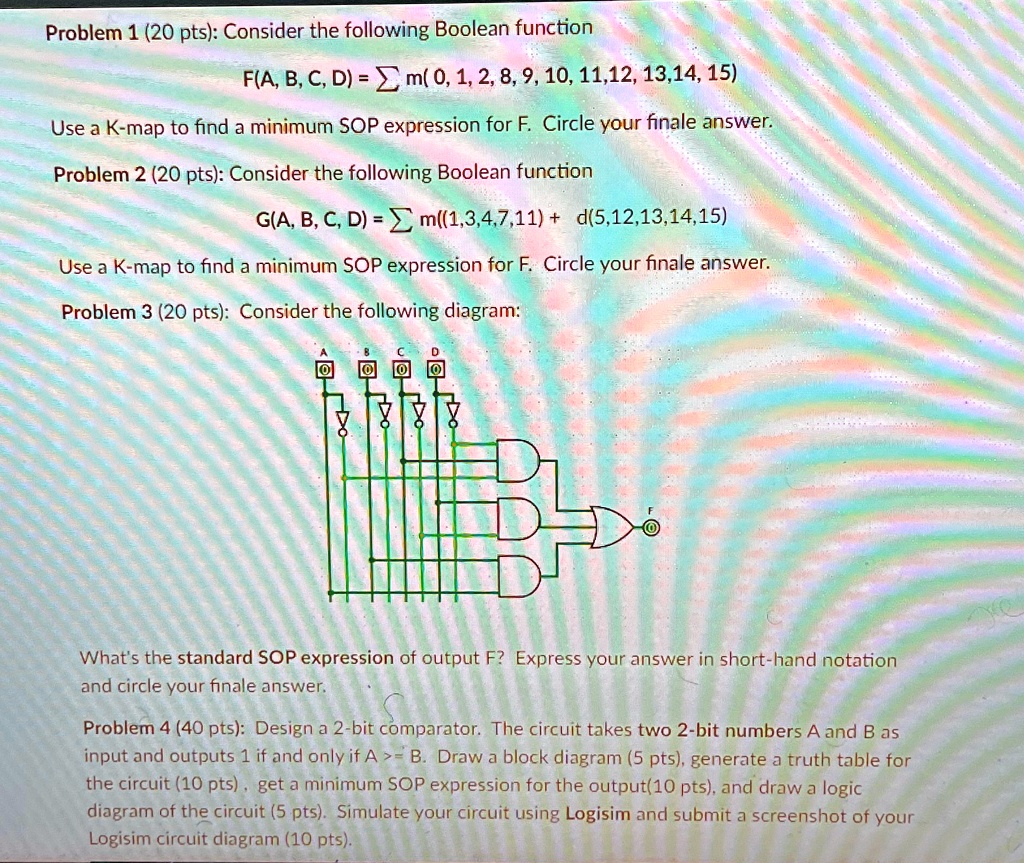
Problem 3 (20 pts): Consider the following diagram:
What's the standard SOP expression of output F? Express your answer in shorthand notation and circle your final answer.
Problem 4 (40 pts): Design a 2-bit comparator. The circuit takes two 2-bit numbers A and B as input and outputs 1 if and only if A>=B. Draw a block diagram (5 pts), generate a truth table for the circuit (10 pts), get a minimum SOP expression for the output (10 pts), and draw a logic diagram of the circuit (5 pts). Simulate your circuit using Logisim and submit a screenshot of your Logisim circuit diagram (10 pts). Use paper and a pencil
Problem 1 (20 pts): Consider the following Boolean function
F(A,B,C,D)=m0,1,2,8,9,10,11,12,13,14,15
Use a K-map to find a minimum SOP expression for F. Circle your final answer.
Problem 2 (20 pts): Consider the following Boolean function
GA,B,C,D)=m1,3,4,7,11+d5,12,13,14,15
Use a K-map to find a minimum SOP expression for F. Circle your final answer.
Problem 3 (20 pts): Consider the following diagram:
What's the standard SOP expression of output F? Express your answer in shorthand notation and circle your final answer
Problem 4 (40 pts): Design a 2-bit comparator. The circuit takes two 2-bit numbers A and B as input and outputs 1 if and only if A>=B. Draw a block diagram (5 pts), generate a truth table for the circuit (10 pts), get a minimum SOP expression for the output (10 pts), and draw a logic diagram of the circuit (5 pts). Simulate your circuit using Logisim and submit a screenshot of your Logisim circuit diagram (10 pts)