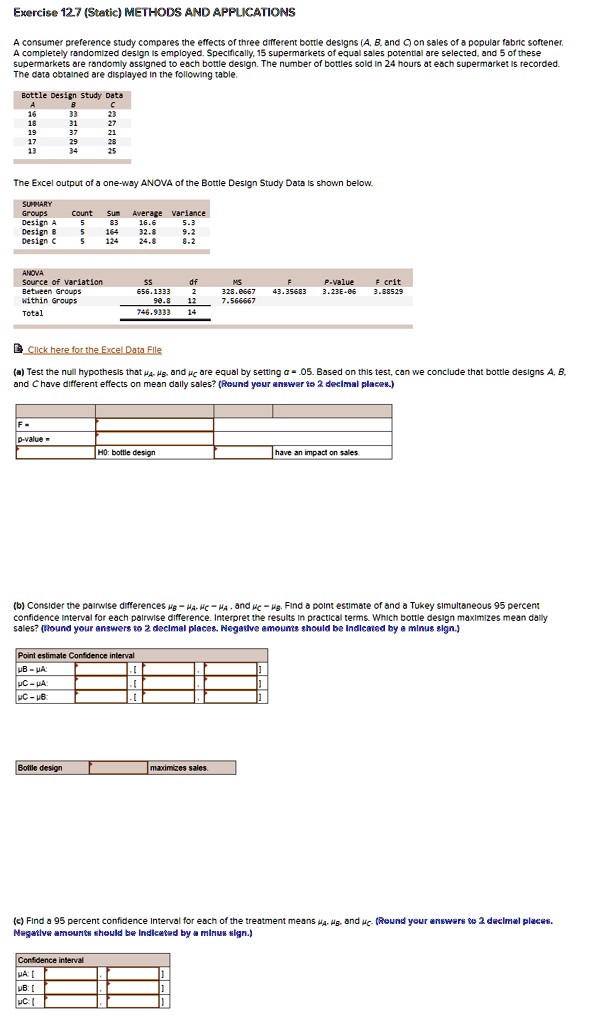
Exercise 12.7 (Static) METHODS AND APPLICATIONS
A consumer preference study compares the effects of three different bottle designs (A, B, and C) on sales of a popular fabric softener.
A completely randomized design is employed. Specifically, 15 supermarkets of equal sales potential are selected, and 5 of these
supermarkets are randomly assigned to each bottle design. The number of bottles sold in 24 hours at each supermarket is recorded.
The data obtained are displayed in the following table.
Bottle Design Study Data
The Excel output of a one-way ANOVA of the Bottle Design Study Data is shown below.
SUMMARY
Groups
Design A
Design B
Design C
Count Sum Average Variance
5 83 16.6 5.3
5 164 32.8 9.2
5 124 24.8 8.2
ANOVA
Source of Variation
Between Groups
Within Groups
Total
SS df MS F P-Value F crit
656.1333 2 328.0667 43.35683 3.23E-06 3.88529
90.8 12 7.566667
746.9333 14
Click here for the Excel Data File
(a) Test the null hypothesis that µ. µε. and uc are equal by setting a.05. Based on this test, can we conclude that bottle designs A, B,
and Chave different effects on mean daily sales? (Round your answer to 2 decimal places.)
p-value-
H0: bottle design
have an impact on sales.
(b) Consider the pairwise differences µg - HA-HC-μα. and µε µg. Find a point estimate of and a Tukey simultaneous 95 percent
confidence interval for each pairwise difference. Interpret the results in practical terms. Which bottle design maximizes mean daily
sales? (Round your answers to 2 decimal places. Negative amounts should be Indicated by a minus sign.)
Point estimate Confidence interval
μΒ - μΑ
μα - μΑ
Bolile design
maximizes sales.
(c) Find a 95 percent confidence Interval for each of the treatment means µ. µg, and uc. (Round your answers to 2 decimal places.
Negative amounts should be indicated by a minus sign.)
Confidence interval
μΑ: [
μΒ: [