Ace - AI Tutor
Ask Our Educators
Textbooks
My Library
Flashcards
Scribe - AI Notes
Notes & Exams
Download App
patricia cabello

patricia c.

Divider

Questions asked

BEST MATCH

5. One model of drug dissolution for oral medications says that the concentration of the drug in the patient's saliva changes at a rate proportional to the difference between the current concentration and a constant $C$. (a) Write an autonomous differential equation for the concentration of the drug at time $t$. (b) Draw a phase line or phase plot, find all equilibria, and classify each as unstable or locally stable. Does it make more sense for the proportionality constant to be positive or negative, and how would this affect the stability of equilibria? (c) Determine the limit of drug concentration as $t \rightarrow \infty$. If this limit depends on the initial condition, describe how. (d) What should the units of $C$ be? (e) Given experimental data from patients, how would you determine the value of $C$?

View Answer
divider
BEST MATCH

Rational investor's are motivated to purchase an asset because of its Question 44 options: all of the above. expected returns. past returns. emotional benefits.

View Answer
divider
BEST MATCH

QUESTION 3 True or False: Benzene undergoes electrophilic substitution reactions. ? True ? False

View Answer
divider
BEST MATCH

Which term describes the process by which children modify their schemata based on new experiences? Assimilation Accommodation Equilibration Adaptation

View Answer
divider
BEST MATCH

Consider spinless fermions moving on a circle with position labeled by the angle varphi such that 0 <= varphi < 2pi. Denote the creation and annihilation operators of these particles as a_(varphi)^(†) and a_(varphi) that satisfy the canonical anti-commutation relations and |0:) is the associated Fock vacuum such that a_(varphi)|0:)=0. Assume periodic boundary conditions. If the Hamilton operator of our quantum system is given by H=ℏomegaint_(0)^(2pi)d varphia_(varphi)^(†)(-(del^(2))/(delvarphi^(2))+(1+cos 2varphi))a_(varphi) where omega is a constant with units of a frequency, answer the questions below. Hint: You can solve the problem numerically by discretizing the problem on a lattice and using a computer to compute eigenvalues and eigenvectors of H and e 1.Consider spinless fermions moving on a circle with position labeled by the angle such that 0 <2T.Denote the creation and annihilation operatorsof these particles as and that satisfy the canonical anti-commutation relations and 0) is the associated Fock vacuum such that a10=0 Assume periodic boundary conditions. If the Hamilton operator of our quantum system is given by 002 +1cos2 H=hw where w is a constant with units of a frequency, answer the questions below. Hint: You can solve the problem numerically by discretizing the problem on a lattice and using a computer to compute eigenvalues and eigenvectors of H and evolve states in time.Just make sure to take the continuum limit of the lattice problem.Your final answers should be accurate to at least 1%. a Compute the ground state energy in units of hw, in the one, two and three fermion sectors. 4 marks bAt t=0 a single fermion is within the region 0 in a Fock state given by (1cos2a10 where N is the normalization constant. Find the probability of finding the particle in the region <2attimes t=f/for f=00.25,0.5,0.751. 6 marks

View Answer
divider
BEST MATCH

12. [-/8.37 Points] DETAILS WANEFMAC7 6.R.024. MY NOTES Solve the game with the given payoff matrix. $P = \begin{bmatrix} -6 & 0 & 1 \\ -9 & 0 & 0 \\ 0 & -1 & -2 \end{bmatrix}$ Find the optimal row player strategy. Find the optimal column player strategy. Find the expected value of the game. Submit Answer

View Answer
divider
BEST MATCH

In the circuit shown in Fig. 8.8, Vg = 0, and Ig = 12.25 mA. Figure 8.8: The circuit for Example 8.4. 25 nF 8Ω a. Calculate the voltage response for t > 0. b. Plot V(t) versus t for the time interval 0 < t < 11 ms.

View Answer
divider
BEST MATCH

List 5 signs and symptoms of fluid volume overload.

View Answer
divider
BEST MATCH

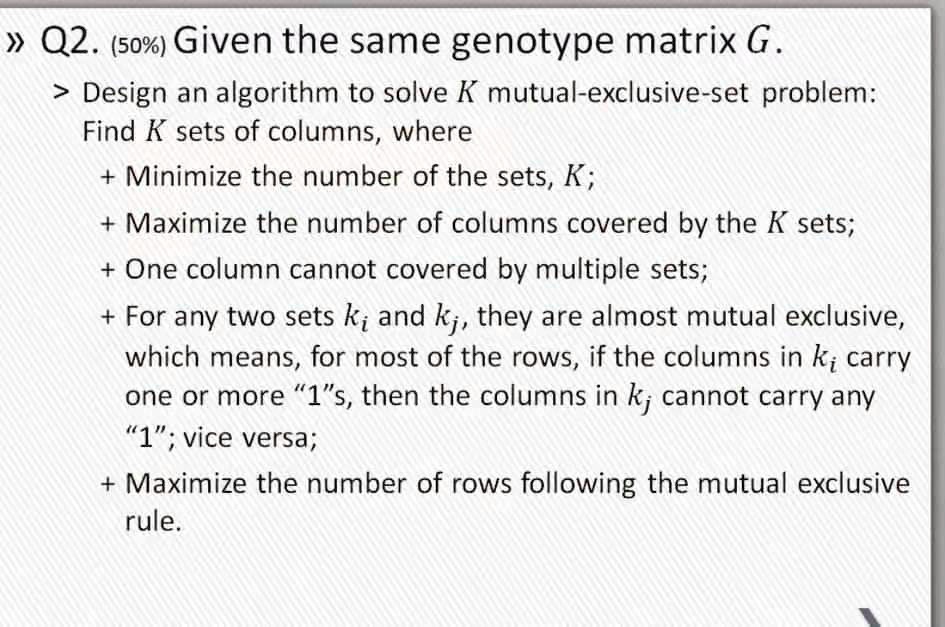
» Q2. (50%) Given the same genotype matrix G. > Design an algorithm to solve K mutual-exclusive-set problem: Find K sets of columns, where + Minimize the number of the sets, K; + Maximize the number of columns covered by the K sets; + One column cannot covered by multiple sets; + For any two sets $k_i$ and $k_j$, they are almost mutual exclusive, which means, for most of the rows, if the columns in $k_i$ carry one or more "1"s, then the columns in $k_j$ cannot carry any "1"; vice versa; + Maximize the number of rows following the mutual exclusive rule.
View Answer
divider
BEST MATCH

When θ is small enough for θ ^3 to be ignored, find approximate expressions for the following. cos 4θ -cos 2θsin 4θ -sin 2θ

View Answer
divider