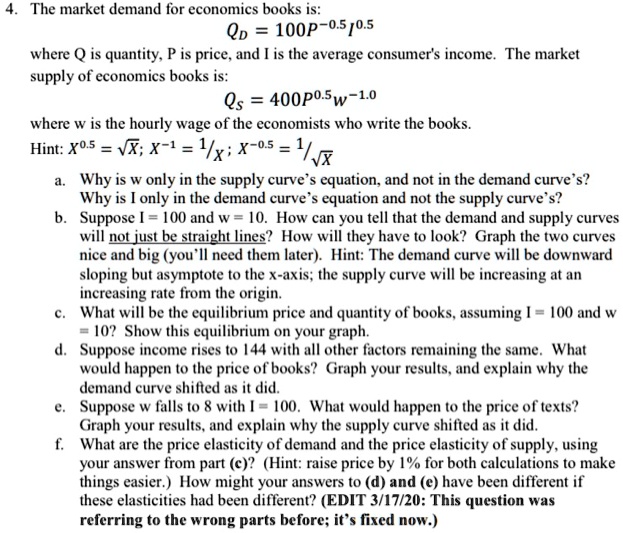
4. The market demand for economics books is:
$Q_D = 100P^{-0.5}I^{0.5}$
where Q is quantity, P is price, and I is the average consumer's income. The market
supply of economics books is:
$Q_S = 400P^{0.5}w^{-1.0}$
where w is the hourly wage of the economists who write the books.
Hint: $X^{0.5} = \sqrt{X}$; $X^{-1} = 1/x$; $X^{-0.5} = 1/\sqrt{X}$
a. Why is w only in the supply curve's equation, and not in the demand curve's?
Why is I only in the demand curve's equation and not the supply curve's?
b. Suppose I = 100 and w = 10. How can you tell that the demand and supply curves
will not just be straight lines? How will they have to look? Graph the two curves
nice and big (you'll need them later). Hint: The demand curve will be downward
sloping but asymptote to the x-axis; the supply curve will be increasing at an
increasing rate from the origin.
c. What will be the equilibrium price and quantity of books, assuming I = 100 and w
= 10? Show this equilibrium on your graph.
d. Suppose income rises to 144 with all other factors remaining the same. What
would happen to the price of books? Graph your results, and explain why the
demand curve shifted as it did.
e. Suppose w falls to 8 with I = 100. What would happen to the price of texts?
Graph your results, and explain why the supply curve shifted as it did.
f. What are the price elasticity of demand and the price elasticity of supply, using
your answer from part (c)? (Hint: raise price by 1% for both calculations to make
things easier.) How might your answers to (d) and (e) have been different if
these elasticities had been different? (EDIT 3/17/20: This question was
referring to the wrong parts before; it's fixed now.)