Please solve the question step by step, thank you so much!
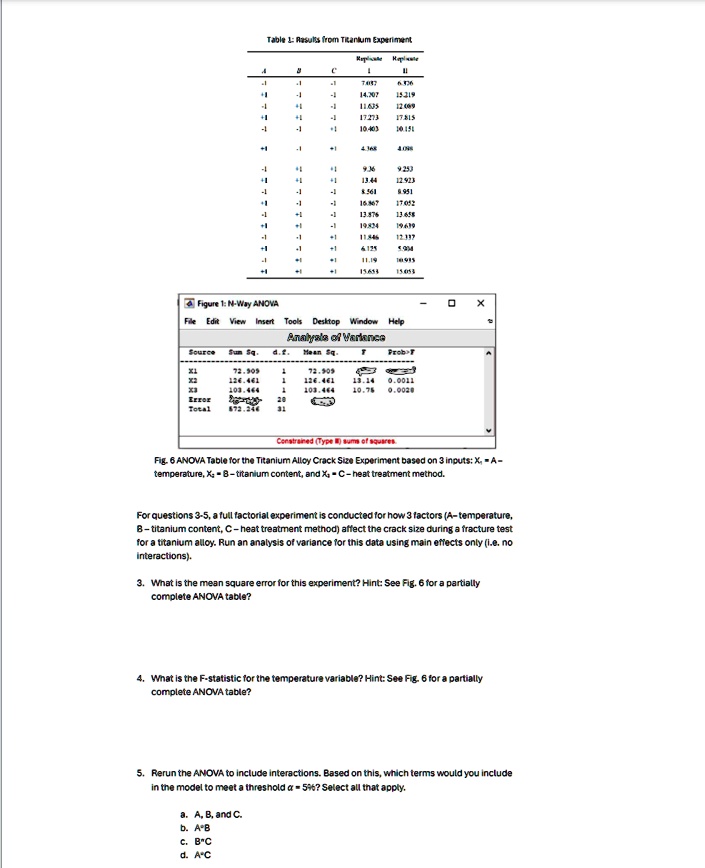
Table 3: Results from Titanium Experiment
Replicate Kepleet I 7.637 6.336 14.387 15.319 11.635 12.669 17.273 17.815 10.403 10.151
c -1 -1 -1 -1 +1
-1 +1 * +1
-1 -1
+1 -1
+1
-1
+1
4.368
4.098
-1
+1 +1 1 1 +1 +1 1 1 *1 +1
+1 +1 -1 -1 1 1 +1 +1
9.36 9.253 13.44 12.923 8.561 8.951 16.867 13.876 13.658 19.834 19.639 11.846 12.3399 6.125 5.906 11.19 16.935 15.653 15.053
-1 +1 -1 +1 -1 +1
+1
+1
Figure: N-Way ANOVA
File Edit View Insert Tools Desktop Window Help Analyze of Variance
Source Sum Sq. d.f. Mean Sq Prob>T
72.599 72.909 126.461 126.461 13.14 0.0011
xa 103.464 103.464 10.75 9.9028
ESzOR Total 72.246 31
Constrained Type I) sums of squares
Fig. 6 ANOVA Table for the Titanium Alloy Crack Size Experiment based on 3 inputs: X=A- temperature, X,B--titanium content, and X,-C-heat treatment method.
For questions 3-5, a full factorial experiment is conducted for how 3 factors (A-temperature, B- titanium content, C-heat treatment method affect the crack size during a fracture test for a titanium alloy. Run an analysis of variance for this data using main effects only (i.e. no interactions).
3. What is the mean square error for this experiment? Hint: See Fig. 6 for a partially complete ANOVA table?
4. What is the F-statistic for the temperature variable? Hint: See Fig. 6 for a partially complete ANOVA table?
5. Rerun the ANOVA to include interactions. Based on this, which terms would you include in the model to meet a threshold = 596? Select all that apply.
a. A, B, and C
b. A*B
c. B*C
d. A*C