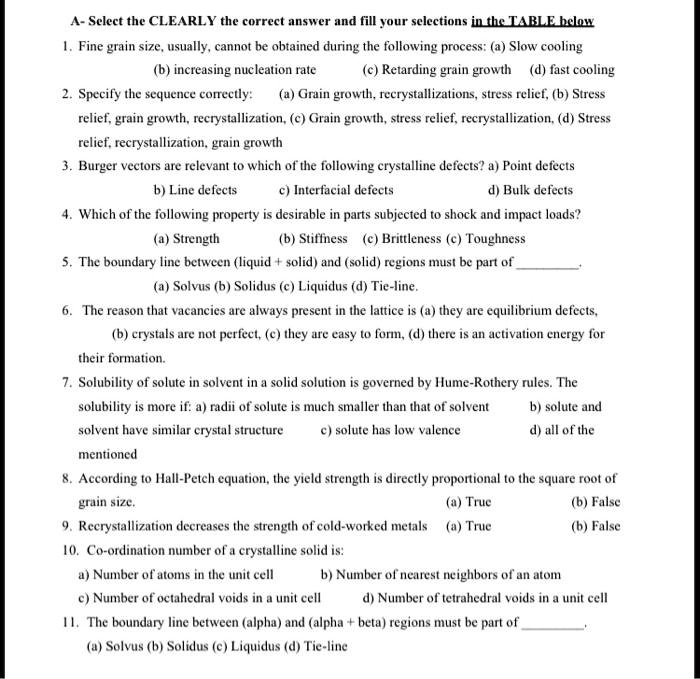
1. Fine grain size, usually, cannot be obtained during the following process: (a) Slow cooling (b) increasing nucleation rate (c) Retarding grain growth (d) fast cooling
2. Specify the sequence correctly: (a) Grain growth, recrystallization, stress relief, (b) Stress relief, grain growth, recrystallization, (c) Grain growth, stress relief, recrystallization, (d) Stress relief, recrystallization, grain growth
3. Burger vectors are relevant to which of the following crystalline defects? (a) Point defects (b) Line defects (c) Interfacial defects (d) Bulk defects
4. Which of the following property is desirable in parts subjected to shock and impact loads? (a) Strength (b) Stiffness (c) Brittleness (d) Toughness
5. The boundary line between (liquid+ solid and (solid regions must be part of (a) Solvus (b) Solidus (c) Liquidus (d) Tie-line.
6. The reason that vacancies are always present in the lattice is (a) they are equilibrium defects, (b) crystals are not perfect, (c) they are easy to form, (d) there is an activation energy for their formation
7. Solubility of solute in solvent in a solid solution is governed by Hume-Rothery rules. The solubility is more if: (a) radii of solute is much smaller than that of solvent (b) solute and solvent have similar crystal structure (c) solute has low valence (d) all of the mentioned
8. According to Hall-Petch equation, the yield strength is directly proportional to the square root of grain size. (a) True (b) False
9. Recrystallization decreases the strength of cold-worked metals. (a) True (b) False
10. Co-ordination number of a crystalline solid is: (a) Number of atoms in the unit cell (b) Number of nearest neighbors of an atom (c) Number of octahedral voids in a unit cell (d) Number of tetrahedral voids in a unit cell
11. The boundary line between alpha and alpha+beta regions must be part of (a) Solvus (b) Solidus (c) Liquidus (d) Tie-line