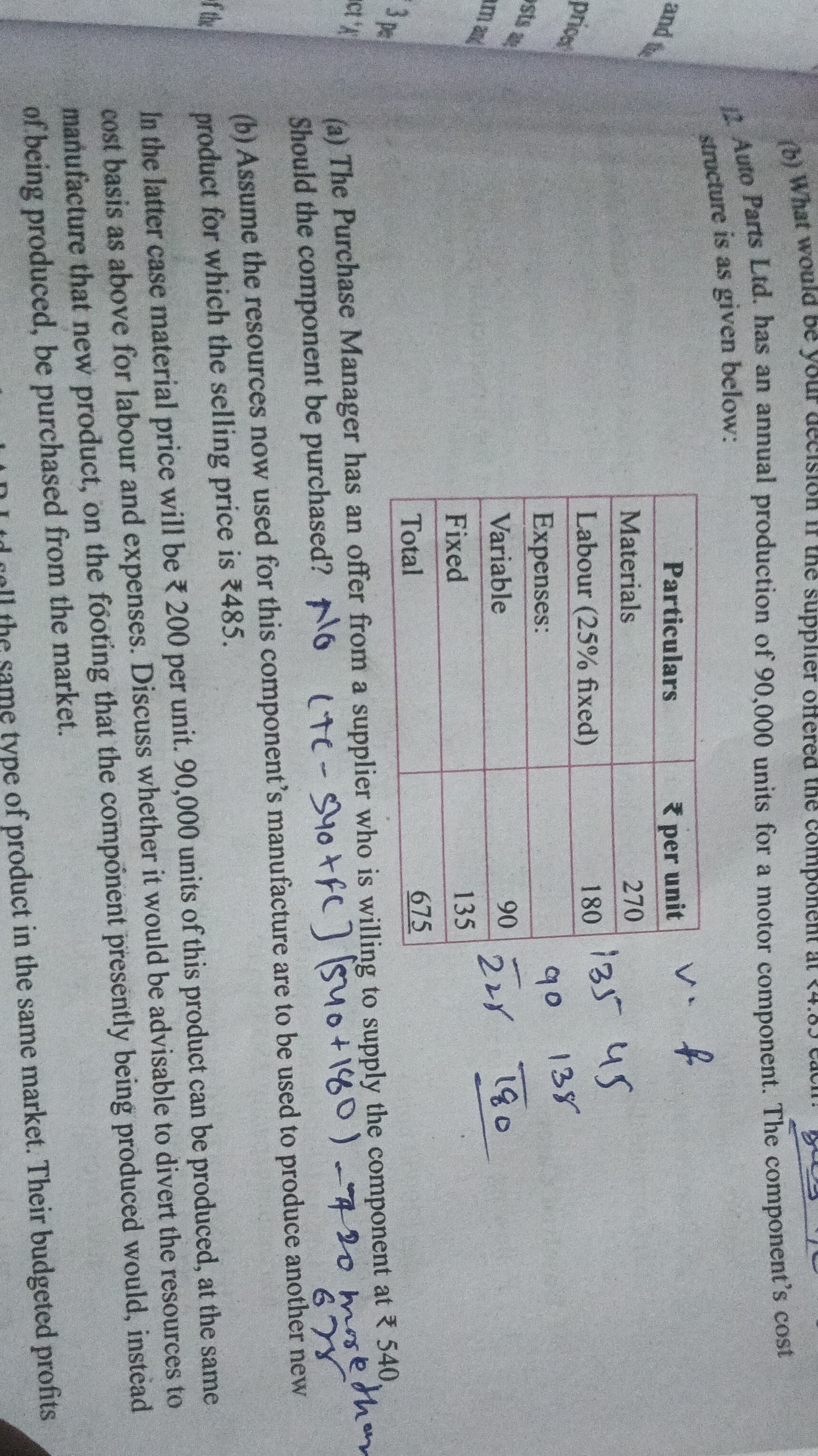
12. Auto Parts Ltd. has an annual production of 90,000 units for a motor component. The component's cost structure is as given below:
\begin{tabular}{|c|c|c|c|}
\hline Particulars & \( ? \) per unit & \multirow{5}{*}{\begin{tabular}{l}
\begin{tabular}{l}
135 \\
90 \\
\( \frac{226}{} \)
\end{tabular}
\end{tabular}} & + \\
\hline Materials & 270 & & \\
\hline Labour ( \( 25 \% \) fixed) & 180 & & \\
\hline Expenses: & & & 138 \\
\hline Variable & 90 & & 180 \\
\hline Fixed & 135 & & \\
\hline Total & 675 & & \\
\hline
\end{tabular}
(a) The Purchase Manager has an offer from a supplier who is willing to supply the component at \( ? 540 \) Should the component be purchased? No (tC - S40 f FC \( ][540+180)-720 \) more then
(b) Assume the resources now used for this component's manufacture are to be used to produce another new product for which the selling price is \( ? 485 \).
In the latter case material price will be ? 200 per unit. 90,000 units of this product can be produced, at the same cost basis as above for labour and expenses. Discuss whether it would be advisable to divert the resources to manufacture that new product, on the footing that the component presently being produced would, instead of being produced, be purchased from the market.