1. Nonisothermal CSTR (18 marks)
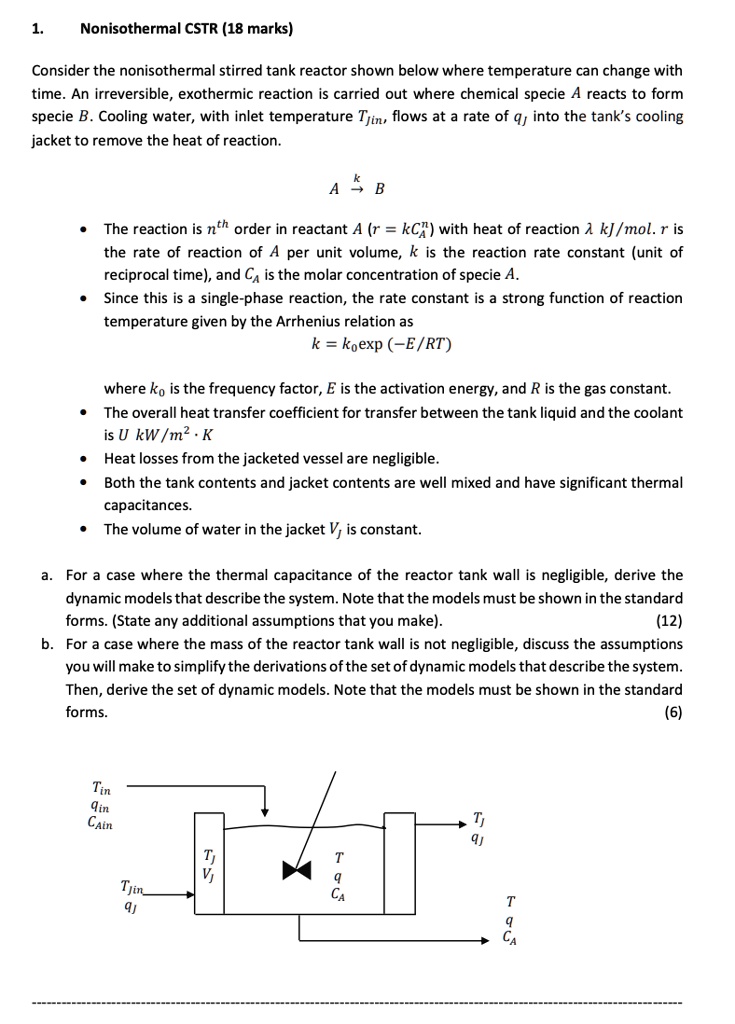
Consider the nonisothermal stirred tank reactor shown below where temperature can change with
time. An irreversible, exothermic reaction is carried out where chemical specie A reacts to form
specie B. Cooling water, with inlet temperature $T_{jin}$, flows at a rate of $q_j$ into the tank's cooling
jacket to remove the heat of reaction.
$A \overset{k}{\rightarrow} B$
\begin{itemize}
\item The reaction is $n^{th}$ order in reactant A ($r = kC_A^n$) with heat of reaction $\lambda$ kJ/mol. r is
the rate of reaction of A per unit volume, k is the reaction rate constant (unit of
reciprocal time), and $C_A$ is the molar concentration of specie A.
\item Since this is a single-phase reaction, the rate constant is a strong function of reaction
temperature given by the Arrhenius relation as
$k = k_0 exp(-E/RT)$
where $k_0$ is the frequency factor, E is the activation energy, and R is the gas constant.
\item The overall heat transfer coefficient for transfer between the tank liquid and the coolant
is U kW/m$^2$.K
\item Heat losses from the jacketed vessel are negligible.
\item Both the tank contents and jacket contents are well mixed and have significant thermal
capacitances.
\item The volume of water in the jacket $V_j$ is constant.
\end{itemize}
a. For a case where the thermal capacitance of the reactor tank wall is negligible, derive the
dynamic models that describe the system. Note that the models must be shown in the standard
forms. (State any additional assumptions that you make).
(12)
b. For a case where the mass of the reactor tank wall is not negligible, discuss the assumptions
you will make to simplify the derivations of the set of dynamic models that describe the system.
Then, derive the set of dynamic models. Note that the models must be shown in the standard
forms.
(6)