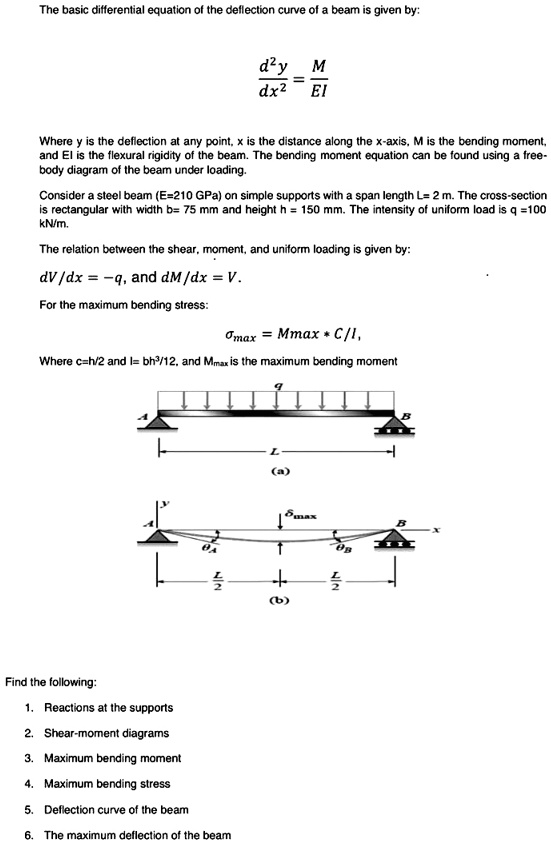
The basic differential equation of the deflection curve of a beam is given by:
$\frac{d^2y}{dx^2} = \frac{M}{EI}$
Where y is the deflection at any point, x is the distance along the x-axis, M is the bending moment,
and EI is the flexural rigidity of the beam. The bending moment equation can be found using a free-
body diagram of the beam under loading.
Consider a steel beam (E=210 GPa) on simple supports with a span length L= 2 m. The cross-section
is rectangular with width b= 75 mm and height h = 150 mm. The intensity of uniform load is q =100
kN/m.
The relation between the shear, moment, and uniform loading is given by:
dV/dx = -q, and dM/dx = V.
For the maximum bending stress:
$\sigma_{max} = M_{max} \cdot C/I$,
Where c=h/2 and I= bh³/12, and $M_{max}$ is the maximum bending moment
Find the following:
1. Reactions at the supports
2. Shear-moment diagrams
3. Maximum bending moment
4. Maximum bending stress
5. Deflection curve of the beam
6. The maximum deflection of the beam