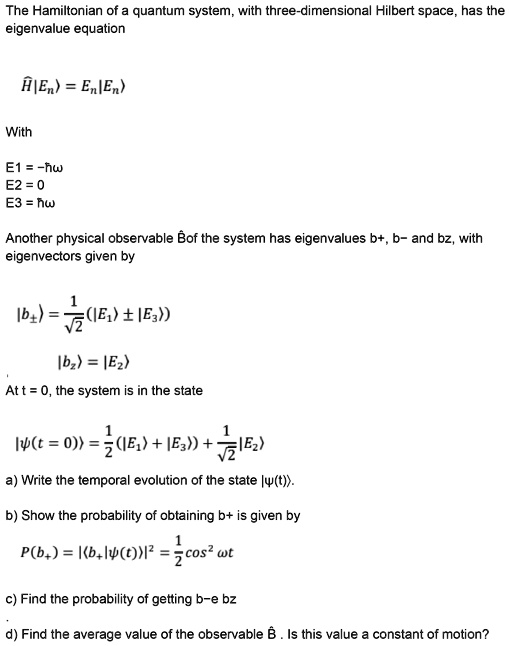
The Hamiltonian of a quantum system, with three-dimensional Hilbert space, has the eigenvalue equation\\
$\hat{H}|E_n\rangle = E_n|E_n\rangle$\\
With\\
$E_1 = -\hbar\omega$\
$E_2 = 0$\
$E_3 = \hbar\omega$\\
Another physical observable $\hat{B}$ of the system has eigenvalues b+, b- and bz, with eigenvectors given by\\
$|b_\pm\rangle = \frac{1}{\sqrt{2}}(|E_1\rangle \pm |E_3\rangle)$\
$|b_z\rangle = |E_2\rangle$\\
At t = 0, the system is in the state\\
$|\psi(t = 0)\rangle = \frac{1}{2}(|E_1\rangle + |E_3\rangle) + \frac{1}{\sqrt{2}}|E_2\rangle$\\
a) Write the temporal evolution of the state $|\psi(t)\rangle$.\\
b) Show the probability of obtaining b+ is given by\\
$P(b_+) = |\langle b_+|\psi(t)\rangle|^2 = \frac{1}{2}cos^2\omega t$\\
c) Find the probability of getting b-e bz\\
d) Find the average value of the observable $\hat{B}$. Is this value a constant of motion?