Let $T: \mathbb{R}^3 \to \mathbb{R}^2$ be the transformation
$T(x, y, z) = (x + z, x - 2z)$
and consider the ordered bases
$E_3 = \{(1, 0, 0), (0, 1, 0), (0, 0, 1)\}$ the standard basis of $\mathbb{R}^3$
$F = \{(0, -1, 1), (1, 0, 2), (-2, 1, 0)\}$ a basis of source $\mathbb{R}^3$
$E_2 = \{(1, 0), (0, 1)\}$ the standard basis of $\mathbb{R}^2$
$G = \{(1, 0), (2, 1)\}$ a basis of target $\mathbb{R}^2$
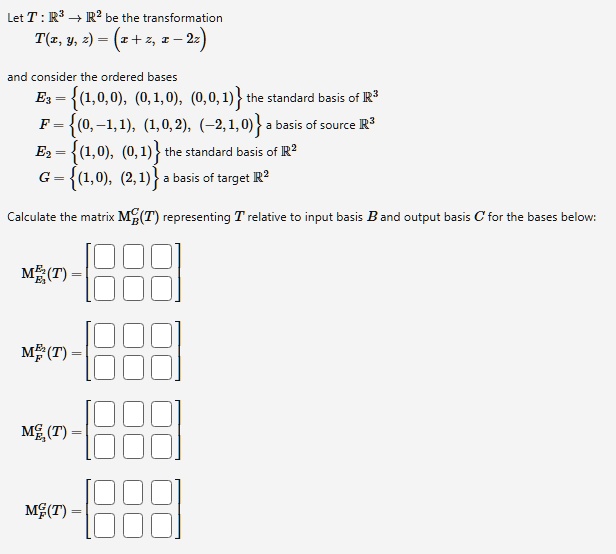
Calculate the matrix $M_G^F(T)$ representing $T$ relative to input basis $B$ and output basis $C$ for the bases below:
$M_{E_2}^{E_3}(T) = \begin{bmatrix} \Box & \Box & \Box \\ \Box & \Box & \Box \end{bmatrix}$
$M_{E_2}^F(T) = \begin{bmatrix} \Box & \Box & \Box \\ \Box & \Box & \Box \end{bmatrix}$
$M_G^{E_3}(T) = \begin{bmatrix} \Box & \Box & \Box \\ \Box & \Box & \Box \end{bmatrix}$
$M_G^F(T) = \begin{bmatrix} \Box & \Box & \Box \\ \Box & \Box & \Box \end{bmatrix}$