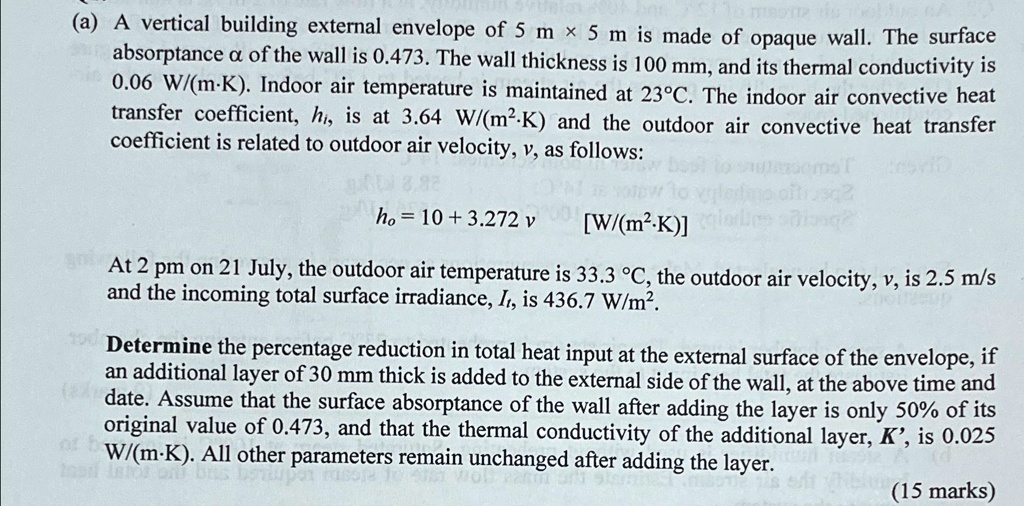
(a) A vertical building external envelope of 5 m x 5 m is made of opaque wall. The surface absorptance \( \alpha \) of the wall is 0.473. The wall thickness is 100 mm, and its thermal conductivity is 0.06 W/(m\cdot K). Indoor air temperature is maintained at 23°C. The indoor air convective heat transfer coefficient, \( h_i \), is at 3.64 W/(m$^2$K) and the outdoor air convective heat transfer coefficient is related to outdoor air velocity, \( v \), as follows:
\( h_o = 10 + 3.272 \ v \)
[W/(m$^2$K)]
At 2 pm on 21 July, the outdoor air temperature is 33.3 °C, the outdoor air velocity, \( v \), is 2.5 m/s and the incoming total surface irradiance, \( I_r \), is 436.7 W/m$^2$.
Determine the percentage reduction in total heat input at the external surface of the envelope, if an additional layer of 30 mm thick is added to the external side of the wall, at the above time and date. Assume that the surface absorptance of the wall after adding the layer is only 50% of its original value of 0.473, and that the thermal conductivity of the additional layer, \( K' \), is 0.025 W/(m\cdot K). All other parameters remain unchanged after adding the layer.
(15 marks)