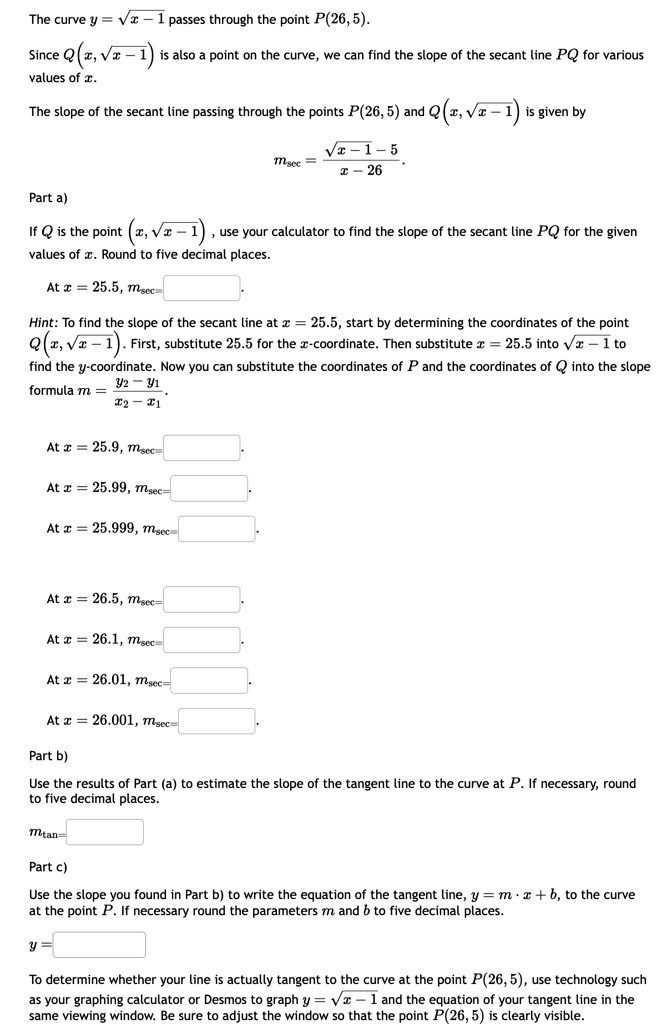
The curve y=sqrt(x-1) passes through the point P(26,5).
Since Q(x,sqrt(x-1)) is also a point on the curve, we can find the slope of the secant line PQ for various
values of x.
The slope of the secant line passing through the points P(26,5) and Q(x,sqrt(x-1)) is given by
m_(sec)=(sqrt(x-1)-5)/(x-26).
Part a)
If Q is the point (x,sqrt(x-1)), use your calculator to find the slope of the secant line PQ for the given
values of x. Round to five decimal places.
At x=25.5,m_(sec)=
Hint: To find the slope of the secant line at x=25.5, start by determining the coordinates of the point
Q(x,sqrt(x-1)). First, substitute 25.5 for the x-coordinate. Then substitute x=25.5 into sqrt(x-1) to
find the y-coordinate. Now you can substitute the coordinates of P and the coordinates of Q into the slope
formula m=(y_(2)-y_(1))/(x_(2)-x_(1)).
At x=25.9,m_(sec)=
At x=25.99,m_(sec)=
At x=25.999,m_(sec)=
At x=26.5,m_(sec)=
At x=26.1,m_(sec)=
At x=26.01,m_(sec)=
At x=26.001,m_(sec)=
Part b)
Use the results of Part (a) to estimate the slope of the tangent line to the curve at P. If necessary, round
to five decimal places.
m_(tan)=
Part c)
Use the slope you found in Part b) to write the equation of the tangent line, y=m*x+b, to the curve
at the point P. If necessary round the parameters m and b to five decimal places.
y=
To determine whether your line is actually tangent to the curve at the point P(26,5), use technology such
as your graphing calculator or Desmos to graph y=sqrt(x-1) and the equation of your tangent line in the
same viewing window. Be sure to adjust the window so that the point P(26,5) is clearly visible.
The curve y = 1 passes through the point P(26, 5).
Since Q(, V -- 1) is also a point on the curve, we can find the slope of the secant line PQ for various values of .
The slope of the secant line passing through the points P(26, 5) and Q(, Vx 1) is given by
x -1-5 Msec: 26
Part a)
If Q is the point (, V -- 1) , use your calculator to find the slope of the secant line PQ for the given values of . Round to five decimal places.
At x=25.5,msc=
Hint: To find the slope of the secant line at = 25.5, start by determining the coordinates of the point Q(, / 1). First, substitute 25.5 for the -coordinate. Then substitute = 25.5 into 1 to find the y-coordinate. Now you can substitute the coordinates of P and the coordinates of Q into the slope 12-y1 formula m= 2-1
At x=25.9,msec
At x=25.99,msec=
At x =25.999,msec
At x=26.5,msec
At x=26.1,mscc=
At x=26.01,msec=
At x = 26.001, msec
Part b)
Use the results of Part (a) to estimate the slope of the tangent line to the curve at P. If necessary, round to five decimal places.
Mtan=
Part c)
Use the slope you found in Part b to write the equation of the tangent line,y= m+b, to the curve at the point P. If necessary round the parameters m and b to five decimal places.
To determine whether your line is actually tangent to the curve at the point P(26,5, use technology such as your graphing calculator or Desmos to graph y= / -1 and the equation of your tangent line in the same viewing window. Be sure to adjust the window so that the point P(26, 5) is clearly visible.