1. Consider two hosts, hA and hB, using the standard TCP implementation where hA has established a connection across a router to hB. Given that hA has a maximum segment size (MSS) of 10,000 bytes, with an initial congestion threshold of 12 segments, and which also needs to transfer 300,000 bytes of data to hB. The round trip time between hA and hB is RTT.
(a) Describe the general operation of this congestion control mechanism if the router has an infinite buffer. In your answer, show hA's congestion window and the sequence of packets transmitted at each round-trip time until the entire file has been transferred to hB.
(b) Repeat question (a) with the router having a finite buffer size of 10 segments.
2. Calculate TCP's timeout value after each of the following sampled RTTs: 30ms, 45ms, 10ms, 300ms. Assuming an initial estimated RTT of 30ms.
3. A TCP sender wants to send a file of size 200 Kbytes to a receiver. The sender uses a packet size of 1 KByte and has its threshold set to 40 KByte. Assume a packet with sequence number 64 is lost, and the RTT is 1 second.
(a) Draw the sender's congestion window growth. Assume that the sender uses TCP Tahoe.
(b) Draw the sender's congestion window growth if the Fast Retransmit and Recovery algorithm is enabled.
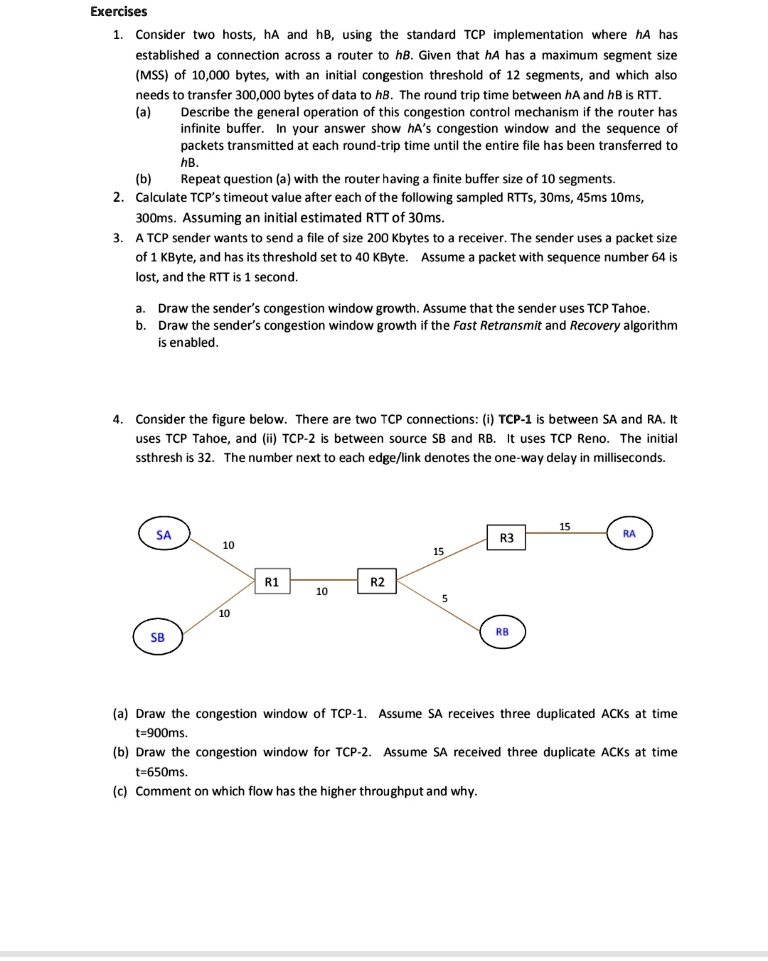
Consider the figure below. There are two TCP connections:
i. TCP-1 is between SA and RA. It uses TCP Tahoe.
ii. TCP-2 is between source SB and RB. It uses TCP Reno.
The initial ssthresh is 32. The number next to each edge/link denotes the one-way delay in milliseconds.
SA
15
10
K1
10
R
(a) Draw the congestion window of TCP-1. Assume SA receives three duplicated ACKs at time t=900ms.
(b) Draw the congestion window for TCP-2. Assume SA received three duplicate ACKs at time t=650ms.
(c) Comment on which flow has the higher throughput and why.