Ace - AI Tutor
Ask Our Educators
Textbooks
My Library
Flashcards
Scribe - AI Notes
Notes & Exams
Download App
paul austin

paul a.

Divider

Questions asked

BEST MATCH

Question 27 Which of the following activities illustrates aerial remote sensing? O over-the-horizon intelligence O identifying possible clandestine grave sites O rescuing lost hikers and mountain climbers O All of the answers are correct. 2 pts

View Answer
divider
BEST MATCH

What must viruses do inside a host cell in order to make new viral particles

View Answer
divider
BEST MATCH

Let us compare a system of \( N \)-independent electrons with pseudo-independent electrons described by the mean-field Hartree-Fock model. Fill the table below. Use Koopmans theorem when appropriate. Define any notations you use, i.e.: \[ \begin{array}{r} h_{i} \equiv h\left(x_{i}\right)=-\frac{1}{2} \nabla_{i}^{2}-\sum_{A} \frac{Z_{A}}{\left|R_{a}-r_{i}\right|} \\ v_{i j} \equiv v\left(x_{i}, x_{j}\right)=\frac{1}{\left|r_{i}-r_{j}\right|} \\ \Phi_{k}=\mid \phi_{1} \phi_{2} \ldots \not \chi_{K} \ldots \phi_{N}> \\ \Phi_{i}^{a}=\mid \phi_{1} \phi_{2} \ldots\left\{\not \phi_{a}\right\} \ldots \phi_{N}> \end{array} \] \begin{tabular}{||l|l|l||} \hline & Independent electrons & Pseudo-independent electrons \\ \hline Hamiltonian & \( H=\sum_{i=1}^{N} \hat{h}_{i} \) & \( H=\sum_{i=1}^{N} \hat{h}_{i}+\frac{1}{2} \sum_{i j=1}^{N} v_{i j} \) \\ \hline Wfn \( \left|\Phi_{0}\right\rangle= \) & \( \left|\phi_{1} \phi_{2} \ldots \phi_{N}\right\rangle \) & \( \left|\phi_{1} \phi_{2} \ldots \phi_{N}\right\rangle \) \\ \hline\( \phi_{i} \) are solutions of: & & \\ \hline Total energy is: & & \\ \hline \begin{tabular}{l} Energy required to remove \\ electron from \( \phi_{k} \) \end{tabular} & & \\ \hline \begin{tabular}{l} Energy for attaching \\ electron to \( \phi_{a} \notin \Phi_{0} \) \end{tabular} & & \\ \hline \begin{tabular}{l} Energy difference between \\ \( \Phi_{k} \) and \( \Phi_{j} \) \end{tabular} & & \\ \hline \begin{tabular}{l} Energy difference between \\ \( \Phi_{0} \) and \( \Phi_{i}^{a} \) \end{tabular} & & \\ \hline \end{tabular}

View Answer
divider
BEST MATCH

Which of the following most accurately describes the health/well-being experience of being single versus being married? Question 59 options: Being single is better than being married. Being married is better than dating. Being married is better than being single, but worse than cohabitating. Cohabiting is better than being married.

View Answer
divider
BEST MATCH

Which term refers to the loss of ability to speak, write, and/or comprehend the written or spoken word? a. amnesia b. insomnia c. anesthesia d. aphasia

View Answer
divider
BEST MATCH

Which of the following is/are commonly associated with IMF conventionalities on lending? privatize national resources and industries credible focus on inflation management fiscal balance all of the above

View Answer
divider
BEST MATCH

Suppose a 250 mL flask is filled with 0.30 mol of NO and 2.0 mol of NO. The following reaction becomes possible: 2NO2 (g) ⇌ 2NO (g) + O2 (g) The equilibrium constant Kc for this reaction is 0.287 at the temperature of the flask. Calculate the equilibrium molarity of NO. Round your answer to two decimal places.

View Answer
divider
BEST MATCH

Write a discussion section explaining the anatomical structures of fungi and the main differences among the three major phyla.

View Answer
divider
BEST MATCH

PROBLEM 9 Lynn Aaron is cranking a Monark arm ergometer at 50 rpm with a resistance of 2.5 kg. This is her maximum workload. Her current body weight is 126 lb. Calculate the following: a. Relative $VO_2$ in ml/kg/min

View Answer
divider
BEST MATCH

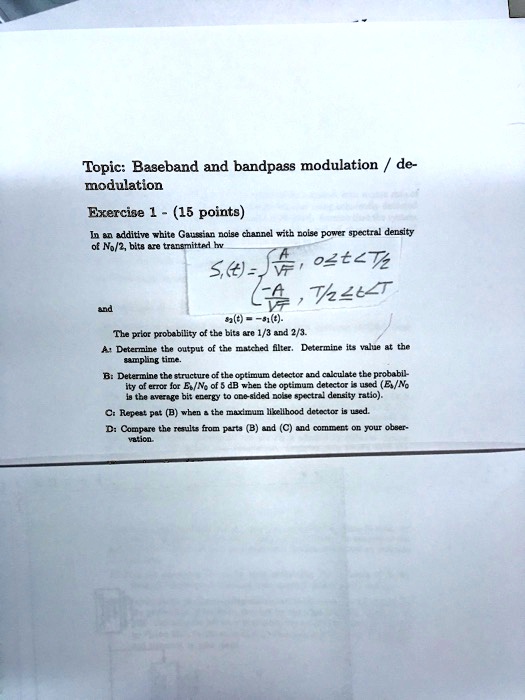
Topic: Baseband and bandpass modulation / de- modulation Exercise 1 (15 points) In an additive white Gaussian noise channel with noise power spectral density of $N_0/2$, bits are transmitted by $$S_1(t) = \begin{cases} \frac{A}{\sqrt{T}}, & 0 \le t < T/2\\ -\frac{A}{\sqrt{T}}, & T/2 \le t < T \end{cases}$$ and $s_2(t) = -s_1(t)$. The prior probability of the bits are 1/3 and 2/3. A: Determine the output of the matched filter. Determine its value at the sampling time. B: Determine the structure of the optimum detector and calculate the probabil- ity of error for $E_b/N_0$ of 5 dB when the optimum detector is used ($E_s/N_0$ is the average bit energy to one-sided noise spectral density ratio). C: Repeat part (B) when a the maximum likelihood detector is used. D: Compare the results from parts (B) and (C) and comment on your obser- vation.
View Answer
divider