Ace - AI Tutor
Ask Our Educators
Textbooks
My Library
Flashcards
Scribe - AI Notes
Notes & Exams
Download App
paul evans

paul e.

Divider

Questions asked

BEST MATCH

An increase in pressure would shift the equillibrium of a reversible reaction

View Answer
divider
BEST MATCH

Question 1 Not yet answered Marked out of 1.00 are the two macro factors that seem to underlie the trend toward greater globalization. Answer The increase in barriers to the free flow of goods, services, and capital that has occurred since the end of World War Il, and global economic stability Technological change and the convergence of global product preferences The decline in barriers to the free flow of goods, services, and capital that has occurred in the past 10 years, and the slowdown in technological change The decline in barriers to the free flow of goods, services, and capital that has occurred since the end of World War II, and technological change The increase in global economic stability, and the slowdown in technological change

View Answer
divider
BEST MATCH

Question 12 2 pts Michelle McCusker was a pregnant unmarried Catholic school teacher at St. Rose of Lima School in Queens, New York. According to a school spokesperson, she was terminated because she violated the school's religious principles by becoming pregnant while unmarried. Using the structural functionalist perspective, the of this policy was to establish the church's authority in regard to sexual behavior. The of this policy was to call into question the church's stance on forgiveness. Omanifest function/dysfunction Omanifest function/latent function latent function/dysfunction latent function/manifest function Question 13 1 pts

View Answer
divider
BEST MATCH

When a surgeon is sued for botching an operation, she likely is charged with A maleficence B malpractice C aggravated negligence D veracity

View Answer
divider
BEST MATCH

Suppose that one variable, x, is chosen randomly and uniformly from [0, 4], and another variable, y, is also chosen randomly and uniformly from [0, 8]. What is the probability that $x \le y \le 2x + 1$? The probability for $x \le y \le 2x + 1$ is

View Answer
divider
BEST MATCH

For the following isotope, give its atomic number, mass number, number of protons, and number of neutrons. \[ { }_{24}^{34} \mathrm{Cr} \] Part 1 of 4 Atomic number \( = \) \( \square \) Part 2 of 4 Mass number \( = \) \( \square \) Part 3 of 4 Number of protons \( = \) \( \square \) Part 4 of 4 Number of neutrons \( = \) \( \square \)

View Answer
divider
BEST MATCH

Atmospheric pressure on Earth at its surface is 101 kPa (101 kilopascals or 101,000 N/m2). Which of these statements is true.

View Answer
divider
BEST MATCH

Roughly what percentage of alcoholism is due to genetic influence? Group of answer choices 50% 0% 80% 20%

View Answer
divider
BEST MATCH

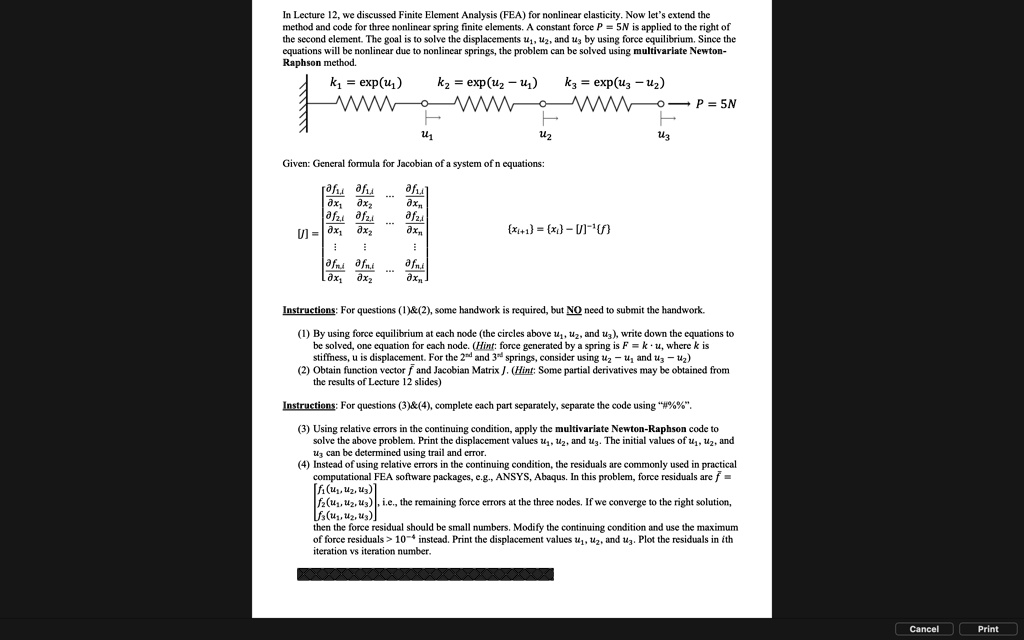
In Lecture 12, we discussed Finite Element Analysis (FEA) for nonlinear elasticity. Now let's extend the method and code for three nonlinear spring finite elements. A constant force P=5N is applied to the right of the second element. The goal is to solve the displacements u1, u2, and u3 by using force equilibrium. Since the equations will be nonlinear due to nonlinear springs, the problem can be solved using multivariate Newton-Raphson method. Given: General formula for Jacobian of a system of n equations: [J]=[[((∂f1,i)/(∂x1)),((∂f1,i)/(∂x2)),...,((∂f1,i)/(∂xn))],[((∂f2,i)/(∂x1)),((∂f2,i)/(∂x2)),...,((∂f2,i)/(∂xn))],[...],[((∂fn,i)/(∂x1)),((∂fn,i)/(∂x2)),...,((∂fn,i)/(∂xn))]] {x(i+1)}={x(i)}-[J]^-1{f} Instructions: For questions (1)&(2), some handwork is required, but NO need to submit the handwork. (1) By using force equilibrium at each node (the circles above u1, u2, and u3), write down the equations to be solved, one equation for each node. (Hint: force generated by a spring is F=k*u, where k is stiffness, u is displacement. For the 2nd and 3rd springs, consider using u2-u1 and u3-u2) (2) Obtain function vector f and Jacobian Matrix J. (Hint: Some partial derivatives may be obtained from the results of Lecture 12 slides) Instructions: For questions (3)&(4), complete each part separately, separate the code using "#%%". (3) Using relative errors in the continuing condition, apply the multivariate Newton-Raphson code to solve the above problem. Print the displacement values u1, u2, and u3. The initial values of u1, u2, and u3 can be determined using trial and error. (4) Instead of using relative errors in the continuing condition, the residuals are commonly used in practical computational FEA software packages, e.g., ANSYS, Abaqus. In this problem, force residuals are f=f1(u1,u2,u3), i.e., the remaining force errors at the three nodes. If we converge to the right solution, then the force residual should be small numbers. Modify the continuing condition and use the maximum of force residuals >10^(-4) instead. Print the displacement values u1, u2, and u3. Plot the residuals in ith iteration vs iteration number.
View Answer
divider
BEST MATCH

14. An economy consists of three sectors: agriculture, industry, and services. To produce $1 worth of agricultural output, the agricultural sector requires $0.3 of its own output, 0.1 of industrial output and $0.4 of services output. On the other hand, to produce $1 worth of industrial output, the industrial sector requires $0.4 of agricultural output, $0.3 of its own output and $0.2 of services output. Finally, to produce $1 worth of services output, the services sector requires $0.1 of agricultural output, $0.4 of industrial output and $0.4 of its own output. a) Derive the technology matrix A from the above information $\begin{bmatrix} 20,000 \\ 30,000 \\ 40,000 \end{bmatrix}$ b) Given that the vector of the final production $X = \begin{bmatrix} 20,000 \\ 30,000 \\ 40,000 \end{bmatrix}$, find the vector of final demand $d$ in the economy

View Answer
divider