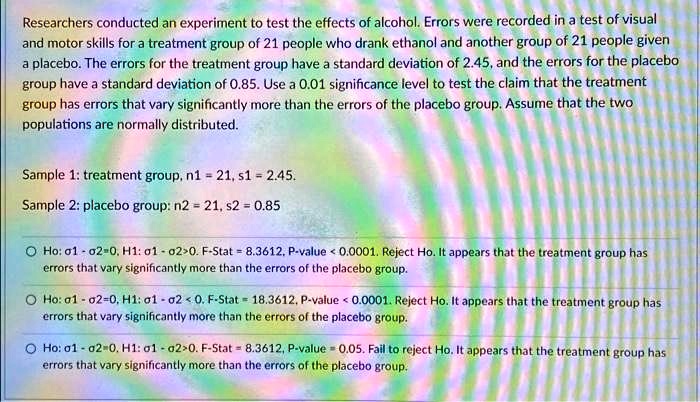
Researchers conducted an experiment to test the effects of alcohol. Errors were recorded in a test of visual
and motor skills for a treatment group of 21 people who drank ethanol and another group of 21 people given
a placebo. The errors for the treatment group have a standard deviation of 2.45, and the errors for the placebo
group have a standard deviation of 0.85. Use a 0.01 significance level to test the claim that the treatment
group has errors that vary significantly more than the errors of the placebo group. Assume that the two
populations are normally distributed.
Sample 1: treatment group, n1 = 21, s1 = 2.45.
Sample 2: placebo group: n2 = 21, s2 = 0.85
? H?: $\sigma_1$ - $\sigma_2$=0, H1: $\sigma_1$ - $\sigma_2$>0. F-Stat = 8.3612, P-value < 0.0001. Reject Ho. It appears that the treatment group has
errors that vary significantly more than the errors of the placebo group.
? H?: $\sigma_1$ - $\sigma_2$=0, H1: $\sigma_1$ - $\sigma_2$ <0. F-Stat = 18.3612, P-value < 0.0001. Reject Ho. It appears that the treatment group has
errors that vary significantly more than the errors of the placebo group.
? H?: $\sigma_1$ - $\sigma_2$=0, H1: $\sigma_1$ - $\sigma_2$>0. F-Stat = 8.3612, P-value = 0.05. Fail to reject Ho. It appears that the treatment group has
errors that vary significantly more than the errors of the placebo group.