Ace - AI Tutor
Ask Our Educators
Textbooks
My Library
Flashcards
Scribe - AI Notes
Notes & Exams
Download App
paul weber

paul w.

Divider

Questions asked

BEST MATCH

Which feature of the immune system will the nurse include when explaining how the immune system works to a patient? Select all that apply. One, some, or all responses may be correct. $\square$ Immunity overactivity is not harmful. $\square$ Immunity protects against harmful cells. $\square$ A reduction in immunity is always permanent. $\square$ Immunity protects against harmful microorganisms. $\square$ Cytokines and growth factors are components of immunity.

View Answer
divider
BEST MATCH

If a 200 g sample of water has 7.4 g of FeCl3 added to it, what is the expected freezing point of the solution? Use Kf = 1.86\deg (C)/(m) for water

View Answer
divider
BEST MATCH

Consider the following differential equation. \[ (\sin (y)-y \sin (x)) d x+(\cos (x)+x \cos (y)-y) d y=0 \] Let \( M=\sin (y)-y \sin (x) \) and \( N=\cos (x)+x \cos (y)-y \). Find the following partial derivatives. \[ \begin{array}{l} M_{y}=\square \\ N_{x}=\square \end{array} \] Let \( \frac{\partial f}{\partial x}=\sin (y)-y \sin (x) \). Integrate each term of this partial derivative with respect to \( x \), letting \( h(y) \) be an unknown function in \( y \). \[ f(x, y)=\square+h(y) \] Find the derivative of \( h(y) \). \[ h^{\prime}(y)=\square \] Is the given differential equation exact? Yes No Determine whether the given differential equation is exact. If it is exact, solve it. (If it is not exact, enter NOT.) \( \square \) Need Help? Read It

View Answer
divider
BEST MATCH

Product/Quotient Rules Given $f(10) = 5$, $g(10) = 2$, $f'(10) = -19$, $g'(10) = 15$. Answer the questions below: a) $k(x) = -9f(x) - 12g(x)$ k'(10) = b) $k(x) = f(x)g(x)$ k'(10) = c) $k(x) = \frac{f(x)}{g(x)}$ k'(10) =

View Answer
divider
BEST MATCH

Which was a triumph of quantum electrodynamics (QED)? Group of answer choices QED predicted the existence of three carrier particles before they were discovered in laboratory experiments. QED unites the strong and weak nuclear forces. QED is an example of a theory of everything. QED successfully explains the origin of quantum mechanical fluctuations in the CBR.

View Answer
divider
BEST MATCH

5.- Calcular el valor de R para que la red de la figura 3.42 le transfería y determinar el valor de dicha potencia máxima.

View Answer
divider
BEST MATCH

A rock of 800 degree celsius is added to water. If 2 of such stones are added, what will be the total temperature of stone

View Answer
divider
BEST MATCH

In our discussion of sex abusers, it was stated that male abusers may be attracted to the oldest daughter in the family. In such cases, the mother is no longer in the picture and the eldest daughter has assumed all of the domestic tasks around the household and acts as a caregiver to her younger siblings. In other words, the daughter has become a ______. Question 22 Answer: a. maternal adolescent b. domestic servant c. mature child d. parentified child e. an ad hoc step-mother

View Answer
divider
BEST MATCH

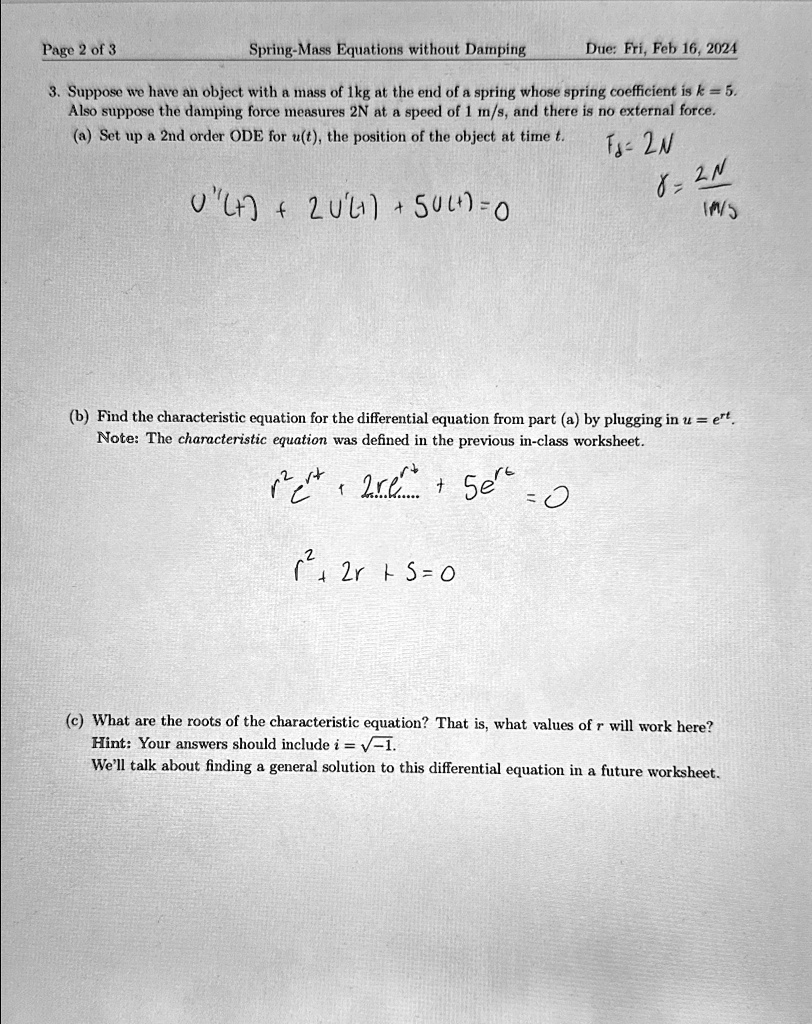
Page 2 of 3 Spring-Mass Equations without Damping Due: Fri, Feb 16, 2024 3. Suppose we have an object with a mass of 1kg at the end of a spring whose spring coefficient is k = 5. Also suppose the damping force measures 2N at a speed of 1 m/s, and there is no external force. (a) Set up a 2nd order ODE for u(t), the position of the object at time t. $u''(t) + 2u'(t) + 5u(t) = 0$ F_\beta = 2N $\gamma = \frac{2N}{1m/s}$ (b) Find the characteristic equation for the differential equation from part (a) by plugging in u = e^{rt}. Note: The characteristic equation was defined in the previous in-class worksheet. r^2e^{rt} + 2re^{rt} + 5e^{rt} = 0 r^2 + 2r + 5 = 0 (c) What are the roots of the characteristic equation? That is, what values of r will work here? Hint: Your answers should include i = \sqrt{-1}. We'll talk about finding a general solution to this differential equation in a future worksheet.
View Answer
divider
BEST MATCH

1 p This type of relationship between variables is often represented by a (inverted) U-shaped graph. It can have both posit and negative relationships between two variables. In a hypothetical example, we can say that one's physical attractiveness increases his/her persuasiveness only up to a certain point. However, too much of physical attractiven may actually backfire in terms of persuasiveness because too much attractiveness becomes a source of distraction. T pattern of relationship is called: partially positive and negative curvilinear taxonomic causation correlation

View Answer
divider