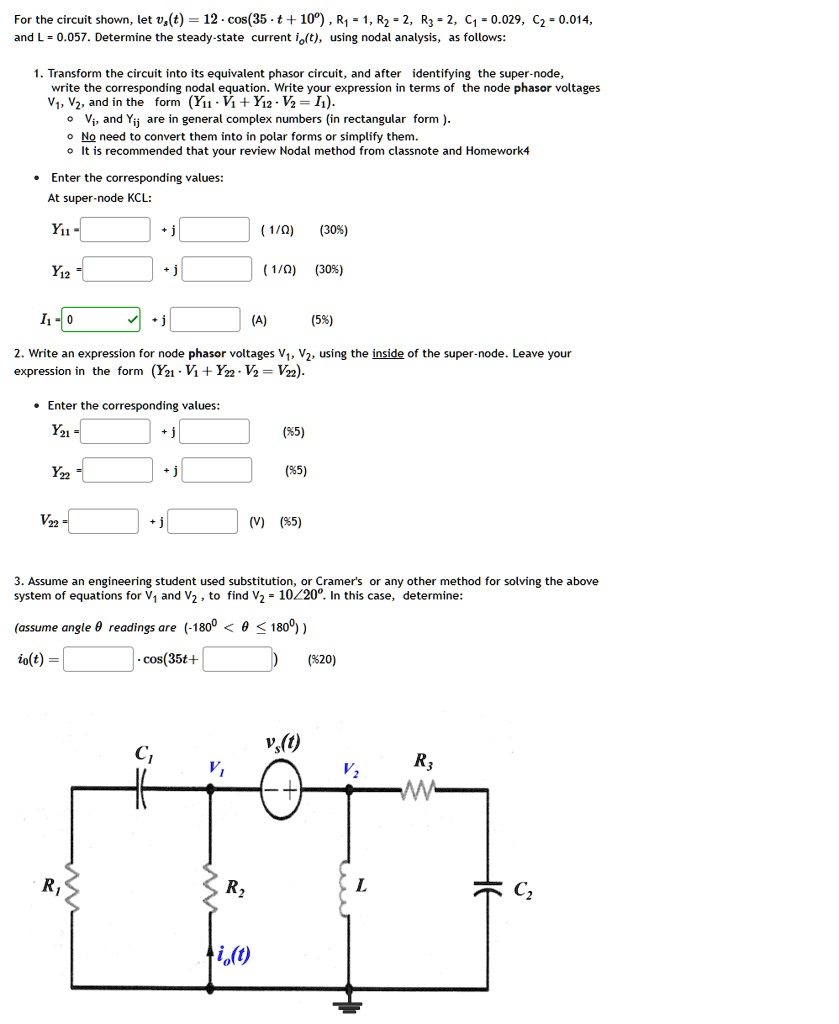
For the circuit shown, let $v_s(t) = 12 \cdot \cos(35t + 10^\circ)$, $R_1 = 1$, $R_2 = 2$, $R_3 = 2$, $C_1 = 0.029$, $C_2 = 0.014$, and $L = 0.057$. Determine the steady-state current $i_o(t)$, using nodal analysis, as follows:
1. Transform the circuit into its equivalent phasor circuit, and after identifying the super-node, write the corresponding nodal equation. Write your expression in terms of the node phasor voltages $V_1$, $V_2$, and in the form $(Y_{11} \cdot V_1 + Y_{12} \cdot V_2 = I_1)$.
* $V_i$, and $Y_{ij}$ are in general complex numbers (in rectangular form).
* No need to convert them into in polar forms or simplify them.
* It is recommended that your review Nodal method from classnote and Homework4
* Enter the corresponding values:
At super-node KCL:
$Y_{11} = $
$Y_{12} = $
$I_1 = 0$
2. Write an expression for node phasor voltages $V_1$, $V_2$, using the inside of the super-node. Leave your expression in the form $(Y_{21} \cdot V_1 + Y_{22} \cdot V_2 = V_{22})$.
* Enter the corresponding values:
$Y_{21} = $
$Y_{22} = $
$V_{22} = $
3. Assume an engineering student used substitution, or Cramer's or any other method for solving the above system of equations for $V_1$ and $V_2$, to find $V_2 = 10 \angle 20^\circ$. In this case, determine:
(assume angle $\theta$ readings are $(-180^\circ < \theta \le 180^\circ)$)
$i_o(t) = $