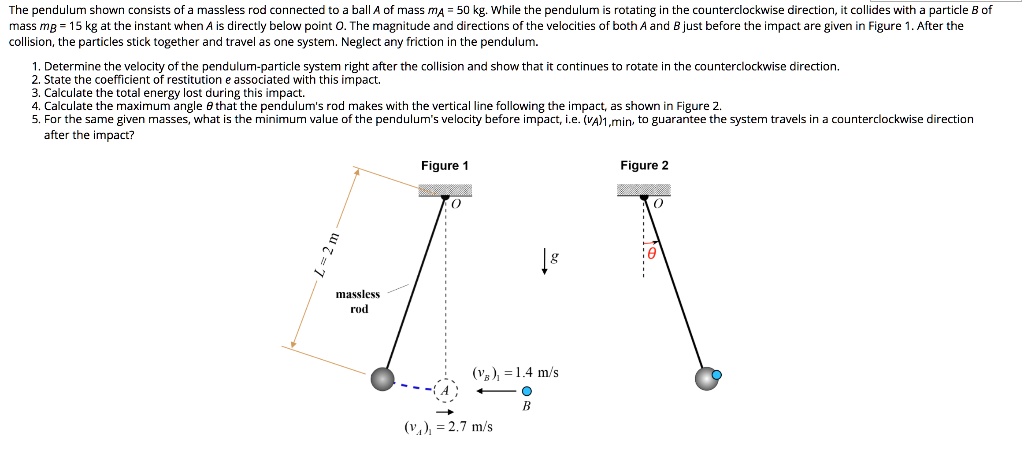
The pendulum shown consists of a massless rod connected to a ball A of mass $m_A = 50$ kg. While the pendulum is rotating in the counterclockwise direction, it collides with a particle B of mass $m_B = 15$ kg at the instant when A is directly below point O. The magnitude and directions of the velocities of both A and B just before the impact are given in Figure 1. After the collision, the particles stick together and travel as one system. Neglect any friction in the pendulum.
1. Determine the velocity of the pendulum-particle system right after the collision and show that it continues to rotate in the counterclockwise direction.
2. State the coefficient of restitution e associated with this impact.
3. Calculate the total energy lost during this impact.
4. Calculate the maximum angle $\theta$ that the pendulum's rod makes with the vertical line following the impact, as shown in Figure 2.
5. For the same given masses, what is the minimum value of the pendulum's velocity before impact, i.e. $(v_A)_1,\text{min}$, to guarantee the system travels in a counterclockwise direction after the impact?