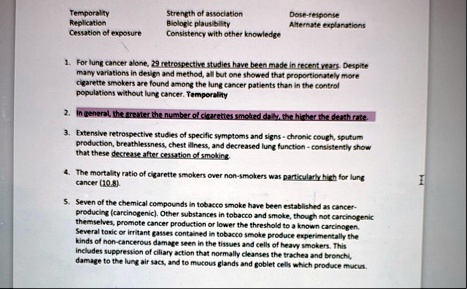
Temporality
Replication
Cessation of exposure
Strength of association
Biologic plausibility
Consistency with other knowledge
Dose-response
Alternate explanations
1. For lung cancer alone, 29 retrospective studies have been made in recent years. Despite
many variations in design and method, all but one showed that proportionately more
cigarette smokers are found among the lung cancer patients than in the control
populations without lung cancer. Temporality
2. In general, the greater the number of cigarettes smoked daily, the higher the death rate.
3. Extensive retrospective studies of specific symptoms and signs-chronic cough, sputum
production, breathlessness, chest illness, and decreased lung function-consistently show
that these decrease after cessation of smoking.
4. The mortality ratio of cigarette smokers over non-smokers was particularly high for lung
cancer (10.8).
5. Seven of the chemical compounds in tobacco smoke have been established as cancer-
producing (carcinogenic). Other substances in tobacco and smoke, though not carcinogenic
themselves, promote cancer production or lower the threshold to a known carcinogen.
Several toxic or irritant gasses contained in tobacco smoke produce experimentally the
kinds of non-cancerous damage seen in the tissues and cells of heavy smokers. This
includes suppression of ciliary action that normally cleanses the trachea and bronchi,
damage to the lung air sacs, and to mucous glands and goblet cells which produce mucus.