Ace - AI Tutor
Ask Our Educators
Textbooks
My Library
Flashcards
Scribe - AI Notes
Notes & Exams
Download App
penny hancock

penny h.

Divider

Questions asked

BEST MATCH

(23)/(13)= convert fraction into mixed numbers. simplify and reduce answer to its lowest terms

View Answer
divider
BEST MATCH

Connect and contrast the following concepts: Inequality of current income versus inequality of lifetime income Functional versus personal income distribution Efficiency versus equity Inequality of income versus inequality of opportunities Wage inequality versus income inequality In each case, make sure you understand each of the concepts and how they are related to each other.

View Answer
divider
BEST MATCH

5 The line \( 3 x+2 y=0 \) meets the \( x \)-axis at the point \( R \). Work out the coordinates of \( R \).

View Answer
divider
BEST MATCH

In 2015, the number of American households owning a cat was estimated to be 13,100,000 fewer than the number of households owning a dog. If 60,200,000 households owned a dog, how many owned a cat?

View Answer
divider
BEST MATCH

Question 16 2 pts What role does the pancreas serve in the body (in the context of the endocrine system)? To regulate fluid balance To produce hormones that regulate the stress response To produce insulin and glucagon to regulate blood sugar To produce hormones that regulate metabolism

View Answer
divider
BEST MATCH

Find the equation of the line passing through the points (5, 7) and (5, 2). Your answer should take the form $x = a$ or $y = a$, whichever is appropriate.

View Answer
divider
BEST MATCH

Different areas of the brain massively overproduce synapses early in development in a process known as ________________, then those regions retract some of those synapses in order to confer efficiency on neural functioning in a process known as _________________.

View Answer
divider
BEST MATCH

Please help, I am confused about answering the following boxes: Problem List/Nursing Diagnosis Prioritize according to Maslow's Hierarchy Anxiety/Concerns/Fear/Knowledge Needs Love/Belonging/Culture Coping/Body Image Comfort/Sexuality Rest/Activity PSYCHIATRIC CLIENT CONCEPT MAP Part I ASSESSMENT/RECOGNIZE CUES Identify relevant and important objective & subjective data from different sources (e.g. medical history, vital signs) Developmental Stage Psychosocial Crisis Health-Illness Continuum: Maximum Health Health Illness Death Respiratory/Circulation Elimination Nutrition/Hydration Urine is dark in color, and large consumption of alcohol leads to dehydration, which decreases urine output. Alcohol affects enzyme secretion, making it difficult to digest food. Loss of appetite N/A Alcohol can cause vomiting, which can lead to both malnourishment and dehydration. Problem List/Nursing Diagnosis Prioritize according to Maslow's Hierarchy 3. *,' Neurological/Neurovascular Safety/Skin/Wounds Drains/Infections/Sensory Slurred speech, impaired balance and gait because Wernicke's area and the cerebellum are affected, and memory becomes impaired. Anxiety/Concerns/Fear/Knowledge Needs N/A Love/Belonging/Culture Coping/Body Image Comfort/Sexuality Rest/Activity

View Answer
divider
BEST MATCH

1. Using the given Java implementation of Dijkstra's algorithm (see video below for more detail), write a Java program that prints all shortest paths from vertex "A" to other vertices in the depicted graph above. Please note that since the given graph is undirected, every undirected edge between vertex u and v represents two directed edges: (1) edge from u to v and (2) edge from v to u.

View Answer
divider
BEST MATCH

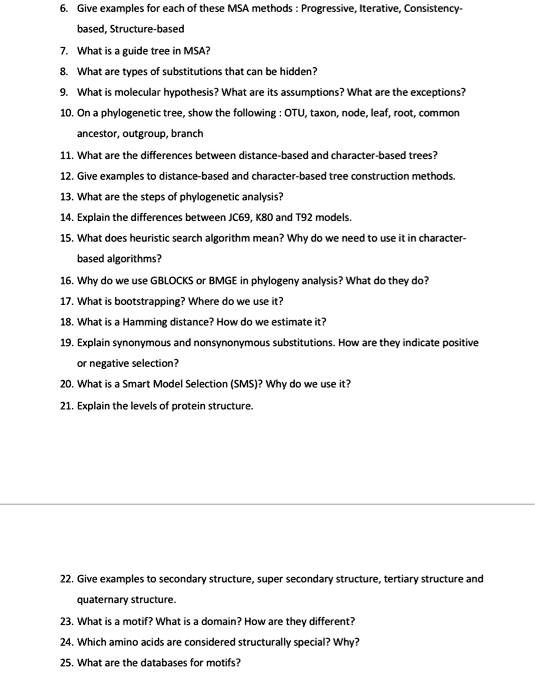
6. Give examples for each of these MSA methods: Progressive, Iterative, Consistency-based, Structure-based 7. What is a guide tree in MSA? 8. What are types of substitutions that can be hidden? 9. What is molecular hypothesis? What are its assumptions? What are the exceptions? 10. On a phylogenetic tree, show the following: OTU, taxon, node, leaf, root, common ancestor, outgroup, branch 11. What are the differences between distance-based and character-based trees? 12. Give examples to distance-based and character-based tree construction methods. 13. What are the steps of phylogenetic analysis? 14. Explain the differences between JC69, K80 and T92 models. 15. What does heuristic search algorithm mean? Why do we need to use it in character-based algorithms? 16. Why do we use GBLOCKS or BMGE in phylogeny analysis? What do they do? 17. What is bootstrapping? Where do we use it? 18. What is a Hamming distance? How do we estimate it? 19. Explain synonymous and nonsynonymous substitutions. How are they indicate positive or negative selection? 20. What is a Smart Model Selection (SMS)? Why do we use it? 21. Explain the levels of protein structure. 22. Give examples to secondary structure, super secondary structure, tertiary structure and quaternary structure. 23. What is a motif? What is a domain? How are they different? 24. Which amino acids are considered structurally special? Why? 25. What are the databases for motifs?
View Answer
divider