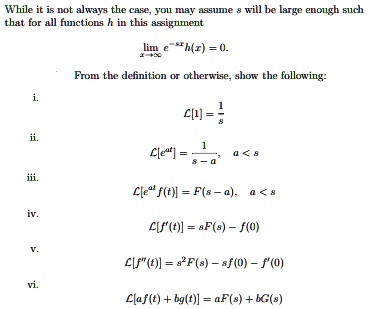
While it is not always the case, you may assume $s$ will be large enough such that for all functions $h$ in this assignment
$\lim_{x \to \infty} e^{-sx}h(x) = 0$.
From the definition or otherwise, show the following:
i.
$\mathcal{L}[1] = \frac{1}{s}$
ii.
$\mathcal{L}[e^{at}] = \frac{1}{s - a}, \quad a < s$
iii.
$\mathcal{L}[e^{at}f(t)] = F(s - a), \quad a < s$
iv.
$\mathcal{L}[f'(t)] = sF(s) - f(0)$
v.
$\mathcal{L}[f''(t)] = s^2F(s) - sf(0) - f'(0)$
vi.
$\mathcal{L}[af(t) + bg(t)] = aF(s) + bG(s)$