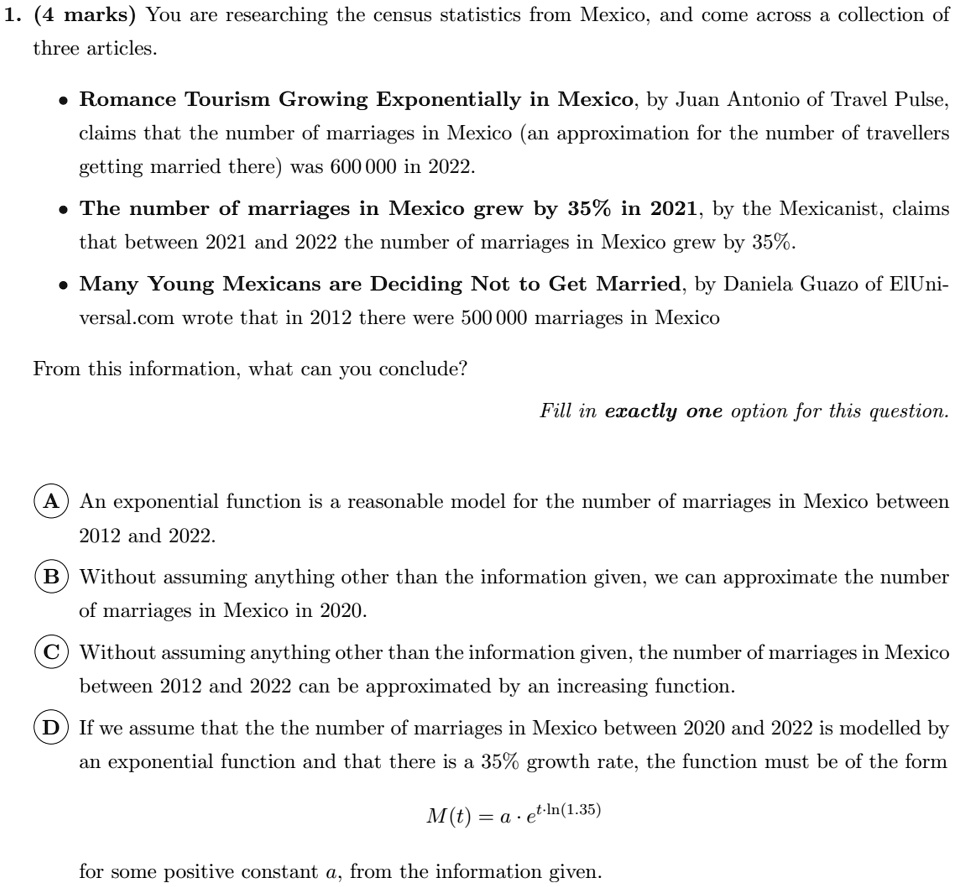
1. (4 marks) You are researching the census statistics from Mexico, and come across a collection of
three articles.
• Romance Tourism Growing Exponentially in Mexico, by Juan Antonio of Travel Pulse,
claims that the number of marriages in Mexico (an approximation for the number of travellers
getting married there) was 600 000 in 2022.
• The number of marriages in Mexico grew by 35% in 2021, by the Mexicanist, claims
that between 2021 and 2022 the number of marriages in Mexico grew by 35%.
• Many Young Mexicans are Deciding Not to Get Married, by Daniela Guazo of ElUni-
versal.com wrote that in 2012 there were 500 000 marriages in Mexico
From this information, what can you conclude?
Fill in exactly one option for this question.
A) An exponential function is a reasonable model for the number of marriages in Mexico between
2012 and 2022.
B) Without assuming anything other than the information given, we can approximate the number
of marriages in Mexico in 2020.
C) Without assuming anything other than the information given, the number of marriages in Mexico
between 2012 and 2022 can be approximated by an increasing function.
D) If we assume that the the number of marriages in Mexico between 2020 and 2022 is modelled by
an exponential function and that there is a 35% growth rate, the function must be of the form
$M(t) = a \cdot e^{t \ln(1.35)}$
for some positive constant $a$, from the information given.