Ace - AI Tutor
Ask Our Educators
Textbooks
My Library
Flashcards
Scribe - AI Notes
Notes & Exams
Download App
phillip crosby

phillip c.

Divider

Questions asked

BEST MATCH

Finding Indefinite Integrals Find the indefinite integral. Check your result by differentiating. See Examples 4 and 5. (Use C for the constant of integration.) 3x^9 − 4/x9 dx

View Answer
divider
BEST MATCH

1. (a) For the circuit given in Figure 1.1, analyze the circuit and solve for $I_{out}$. All the values given are in the phasor domain. $-j4 \Omega$ $j8 \Omega$ $I_{out}$ $j2 \Omega$ $5 \angle 70^\circ V$ $j3 \Omega$ $6 \Omega$

View Answer
divider
BEST MATCH

For the following reaction, what significant change(s) would be expected in IR (ignore C-H absorptions)? H$_3$O$^+$ A peak around 2200 cm$^{-1}$ would disappear and a new peak around 1700 cm$^{-1}$ will appear No change would be observed A peak around 2200 cm$^{-1}$ would disappear and a new peak around 3300 cm$^{-1}$ will appear A peak around 1700 cm$^{-1}$ will appear

View Answer
divider
BEST MATCH

Training in the ______________ allows students to learn how to conduct objective research. scientific inquiry scientific method research inquiry research method

View Answer
divider
BEST MATCH

What are some difficulties associated with using Geons for object recognition? Group of answer choices: - The set of Geons was not specified precisely enough - Lack of feedback connections - Inability to make use of contextual information - Lack of information about the size of the components and difficulty in extracting Geons from real images

View Answer
divider
BEST MATCH

b) $2log_63 + \frac{1}{2}log_636 + log_64$

View Answer
divider
BEST MATCH

Charlie's utility is 100 and Dylan's utility is 50. Therefore, Charlie must be happier than Dylan.

View Answer
divider
BEST MATCH

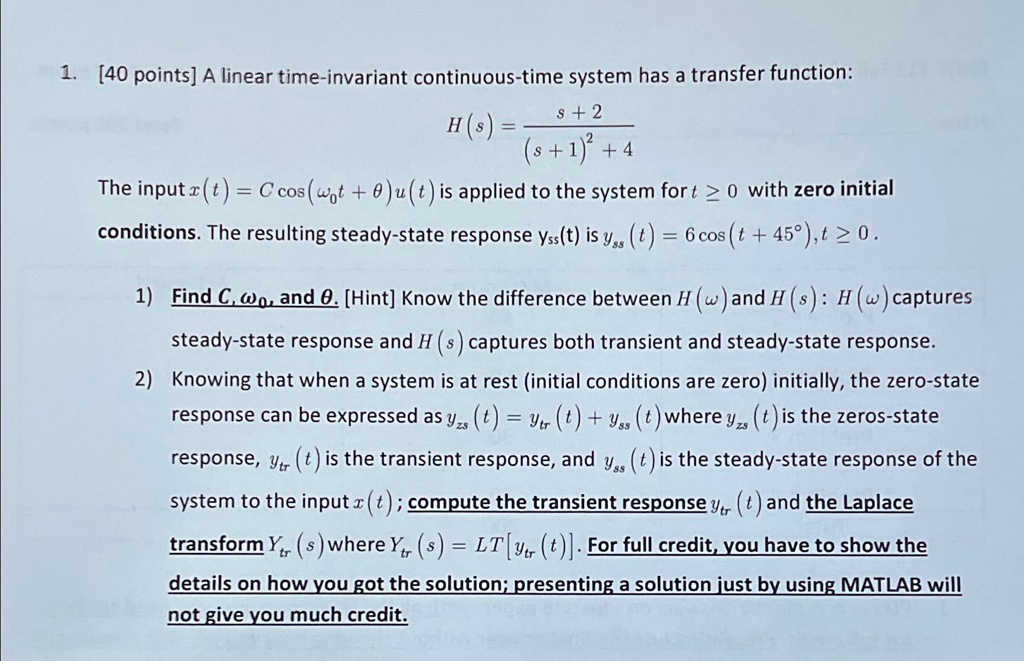
[40 points] A linear time-invariant continuous-time system has a transfer function: $H(s) = \frac{s + 2}{(s + 1)^2 + 4}$ The input $x(t) = C \cos(\omega_0 t + \theta)u(t)$ is applied to the system for $t \ge 0$ with zero initial conditions. The resulting steady-state response $y_{ss}(t)$ is $y_{ss}(t) = 6\cos(t + 45^\circ)$, $t \ge 0$. 1) Find C, $\omega_0$, and $\theta$. [Hint] Know the difference between $H(\omega)$ and $H(s)$: $H(\omega)$ captures steady-state response and $H(s)$ captures both transient and steady-state response. 2) Knowing that when a system is at rest (initial conditions are zero) initially, the zero-state response can be expressed as $y_{zs}(t) = y_{tr}(t) + y_{ss}(t)$ where $y_{zs}(t)$ is the zeros-state response, $y_{tr}(t)$ is the transient response, and $y_{ss}(t)$ is the steady-state response of the system to the input $x(t)$; compute the transient response $y_{tr}(t)$ and the Laplace transform $Y_{tr}(s)$ where $Y_{tr}(s) = \mathcal{L}T[y_{tr}(t)]$. For full credit, you have to show the details on how you got the solution; presenting a solution just by using MATLAB will not give you much credit.
View Answer
divider
BEST MATCH

Table 15.2 Classes of animals and their characteristics Group of Animals Major Characteristics Invertebrates Class Scyphozoa (jellyfishes) Class Turbellaria (flatworms) Class Gastropoda (gastropods) Class Bivalvia (bivalves) Class Echinoidea (sea urchins) Class Crustacea (crustaceans) Class Insecta (insects) Class Arachnida (arachnids) Class Chilopoda (centipedes) Vertebrates Class Osteichthyes (bony fishes) Class Amphibia (amphibians) Class Reptilia (reptilians) Class Aves (birds) Class Mammalia (mammals)

View Answer
divider
BEST MATCH

Solve $9\cos(2t) = 9\sin^2(t) + 4$ for all solutions $0 \le t < 2\pi$ $t = 2.41 + \pi n, 0.73\pi n$ incomplete.

View Answer
divider