Ace - AI Tutor
Ask Our Educators
Textbooks
My Library
Flashcards
Scribe - AI Notes
Notes & Exams
Download App
phillip tirado

phillip t.

Divider

Questions asked

BEST MATCH

Question 4. 1. Find (a) $<A,B>$, (b) $||A||$, (c) $||B||$, and (d) $d(A,B)$ for the inner product defined by $<A,B> = 2a_{11}b_{11} + a_{12}b_{12} + a_{21}b_{21} + 2a_{22}b_{22}$ on $M_{22}$ where $A = \begin{pmatrix} 1 & 0 \\ 0 & -1 \end{pmatrix}$, $B = \begin{pmatrix} 0 & 1 \\ 0 & -1 \end{pmatrix}$

View Answer
divider
BEST MATCH

Which of these major issues is NOT among those emphasized by developmental psychologists? continuity and stages person and situation nature and nurture stability and change

View Answer
divider
BEST MATCH

Match different parts of the ear with its associated structures. Question 10 options: Auricle, ear canal and the tympanic membrane. Ear ossicles Cochlea and vestibule 1. External ear 2. Middle ear 3. Internal ear

View Answer
divider
BEST MATCH

Abdul shows interest in art, so his dad teaches him how to paint. He explains the importance of choosing different types of paint and guides Abdul’s movements. What type of parental socialization does this exemplify? Group of answer choices Social management Direct instruction Indirect socialization None of these Indirect instruction

View Answer
divider
BEST MATCH

Which of these are associated with sleeping EEG activity (not including REM sleep)?

View Answer
divider
BEST MATCH

Which form of government grants almost all power to an individual leader? A Socialism B Autocracy C Aristocracy D Direct democracy E Representative democracy

View Answer
divider
BEST MATCH

28. * It does not matter much whether professionals practice. Correct Incorrect

View Answer
divider
BEST MATCH

Suppose that the government imposes a tax of $0.30 per can on the sellers of soda. What price do consumers pay for a can of soda after the imposition of this tax? Suppose that the government imposes a tax of $0.30 per can on the sellers of soda. What price do sellers receive for a can of soda after the imposition of this tax?

View Answer
divider
BEST MATCH

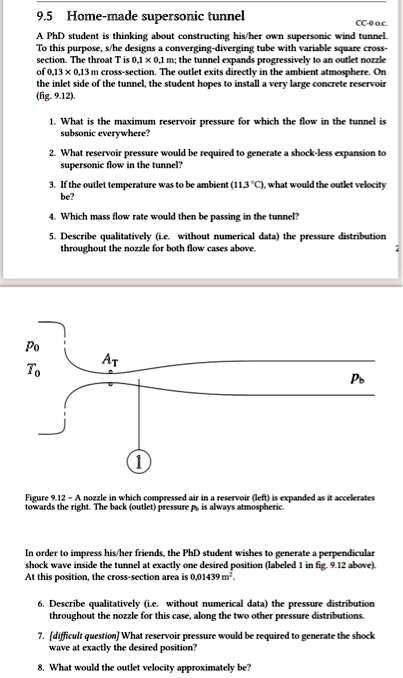
9.5 Home-made supersonic tunnel CC-??? A PhD student is thinking about constructing his/her own supersonic wind tunnel. To this purpose, s/he designs a converging-diverging tube with variable square cross- section. The throat T is 0,1 x 0,1 m; the tunnel expands progressively to an outlet nozzle of 0,13 x 0,13 m cross-section. The outlet exits directly in the ambient atmosphere. On the inlet side of the tunnel, the student hopes to install a very large concrete reservoir (fig. 9.12). 1. What is the maximum reservoir pressure for which the flow in the tunnel is subsonic everywhere? 2. What reservoir pressure would be required to generate a shock-less expansion to supersonic flow in the tunnel? 3. If the outlet temperature was to be ambient (11,3 °C), what would the outlet velocity be? 4. Which mass flow rate would then be passing in the tunnel? 5. Describe qualitatively (ie. without numerical data) the pressure distribution throughout the nozzle for both flow cases above. $P_0$ $T_0$ $A_T$ $P_b$ Figure 9.12-A nozzle in which compressed air in a reservoir (left) is expanded as it accelerates towards the right. The back (outlet) pressure $p_b$ is always atmospheric. In order to impress his/her friends, the PhD student wishes to generate a perpendicular shock wave inside the tunnel at exactly one desired position (labeled 1 in fig. 9.12 above). At this position, the cross-section area is 0,01439 m². 6. Describe qualitatively (ie. without numerical data) the pressure distribution throughout the nozzle for this case, along the two other pressure distributions. 7. (difficult question] What reservoir pressure would be required to generate the shock wave at exactly the desired position? 8. What would the outlet velocity approximately be?
View Answer
divider
BEST MATCH

Texts: A space is kept at -13°C by a vapor-compression refrigeration system in an ambient at 25°C. The space gains heat steadily at a rate of 3100 kJ/h, and the rate of heat rejection in the condenser is 5300 kJ/h. Determine the power input, in kW, the COP of the cycle, and the second-law efficiency of the system. The power input is kW. The COP of the cycle is . The second-law efficiency of the system is %.

View Answer
divider