Ace - AI Tutor
Ask Our Educators
Textbooks
My Library
Flashcards
Scribe - AI Notes
Notes & Exams
Download App
pothu Raju

pothu R.

Divider

Viewed Questions

Multiple Choice The sequence $a_{1}=5, a_{n}=3 a_{n-1}$ is an example of a(n) _______ sequence. 
(a) alternating
(b) recursive
(c) Fibonacci
(d) summation

Multiple Choice The sequence $a_{1}=5, a_{n}=3 a_{n-1}$ is an example of a(n) _______ sequence. (a) alternating (b) recursive (c) Fibonacci (d) summation

Algebra and Trigonometry

Sequences; Induction; the Binomial…

Sequences

For the function $f(x)=\frac{x-1}{x},$ find $f(2)$ and $f(3)$

Algebra and Trigonometry

Sequences; Induction; the Binomial…

Sequences

Use a graphing utility to find the quadratic function of best fit for the data below. $$
\begin{array}{l|ccccc|}
\hline \mathrm{x} & 2 & 2.5 & 3 & 3.5 & 4 \\
\mathrm{y} & 3.08 & 3.42 & 3.65 & 3.82 & 3.6 \\
\hline
\end{array}
$$

Use a graphing utility to find the quadratic function of best fit for the data below. $$ \begin{array}{l|ccccc|} \hline \mathrm{x} & 2 & 2.5 & 3 & 3.5 & 4 \\ \mathrm{y} & 3.08 & 3.42 & 3.65 & 3.82 & 3.6 \\ \hline \end{array} $$

Algebra and Trigonometry

Polynomial and Rational Functions

Graphing Polynomial Functions; Models

Ten subjects with borderline-high cholesterol levels were randomly recruited for a study that involved taking a nutrition education class. Cholesterol readings were taken before the class and 3 months after the class.
Let $d=$ preclass cholesterol $-$ postclass cholesterol. Excel was used to find the $95 \%$ confidence interval for the mean amount of reduction in cholesterol readings after taking the nutrition education class. Verify the results shown on the output by calculating the values yourself. Assume normality.

Ten subjects with borderline-high cholesterol levels were randomly recruited for a study that involved taking a nutrition education class. Cholesterol readings were taken before the class and 3 months after the class. Let $d=$ preclass cholesterol $-$ postclass cholesterol. Excel was used to find the $95 \%$ confidence interval for the mean amount of reduction in cholesterol readings after taking the nutrition education class. Verify the results shown on the output by calculating the values yourself. Assume normality.

Elementary Statistics

Inferences Involving Two Populations

Inferences Concerning the Mean…

Questions asked

INSTANT ANSWER

A survey was conducted at a local ballroom dance studio asking 71 students if they had ever competed in the following dance categories: - Smooth - Rhythm - Standard The results were then presented to the owner in the following Venn Diagram. Use the Venn Diagram to determine the following probabilities. Write your answers in decimal form, rounded to the nearest hundreth. A. If a student is chosen at random, what is the probability that the student competed in Rhythm GIVEN they had competed in Smooth. P (Rhythm | Smooth) is equal to \( \square \) B. If a student is chosen at random, what is the probability that the student competed in Rhythm GIVEN they had competed in Standard. \( \mathrm{P}( \) Rhythm | Standard \( ) \) is equal to \( \square \) C. If a student is chosen at random, what is the probability that the student competed in Standard GIVEN they had competed in Rhythm. \( \mathrm{P}( \) Standard | Rhythm ) is equal to \( \square \) D. If a student is chosen at random, what is the probability that the student competed in Rhythm GIVEN they had competed in Smooth or Standard. P (Rhythm | Smooth or Standard) is equal to \( \square \)

View Answer
divider
INSTANT ANSWER

A survey was conducted at a local ballroom dance studio asking 71 students if they had ever competed in the following dance categories: - Smooth - Rhythm - Standard The results were then presented to the owner in the following Venn Diagram. Use the Venn Diagram to determine the following probabilities. Write your answers in decimal form, rounded to the nearest hundreth. A. If a student is chosen at random, what is the probability that the student competed in Rhythm GIVEN they had competed in Smooth. P (Rhythm | Smooth) is equal to \( \square \) B. If a student is chosen at random, what is the probability that the student competed in Rhythm GIVEN they had competed in Standard. \( \mathrm{P}( \) Rhythm | Standard \( ) \) is equal to \( \square \) C. If a student is chosen at random, what is the probability that the student competed in Standard GIVEN they had competed in Rhythm. \( \mathrm{P}( \) Standard | Rhythm ) is equal to \( \square \) D. If a student is chosen at random, what is the probability that the student competed in Rhythm GIVEN they had competed in Smooth or Standard. P (Rhythm | Smooth or Standard) is equal to \( \square \)

View Answer
divider
INSTANT ANSWER

The test statistic of z = - 2.36 is obtained when testingthe claim that p < 0.56.a. Using a significance level of a = 0.05, find thecritical value(s) .b. Should we reject Ho or should we fail to reject Ho ?a. The critical values) is/ are z = (Round to two decimal places as needed. Use a comma to separate answers as needed.)

View Answer
divider
ANSWERED

Ivan Kochetkov verified

Numerade educator

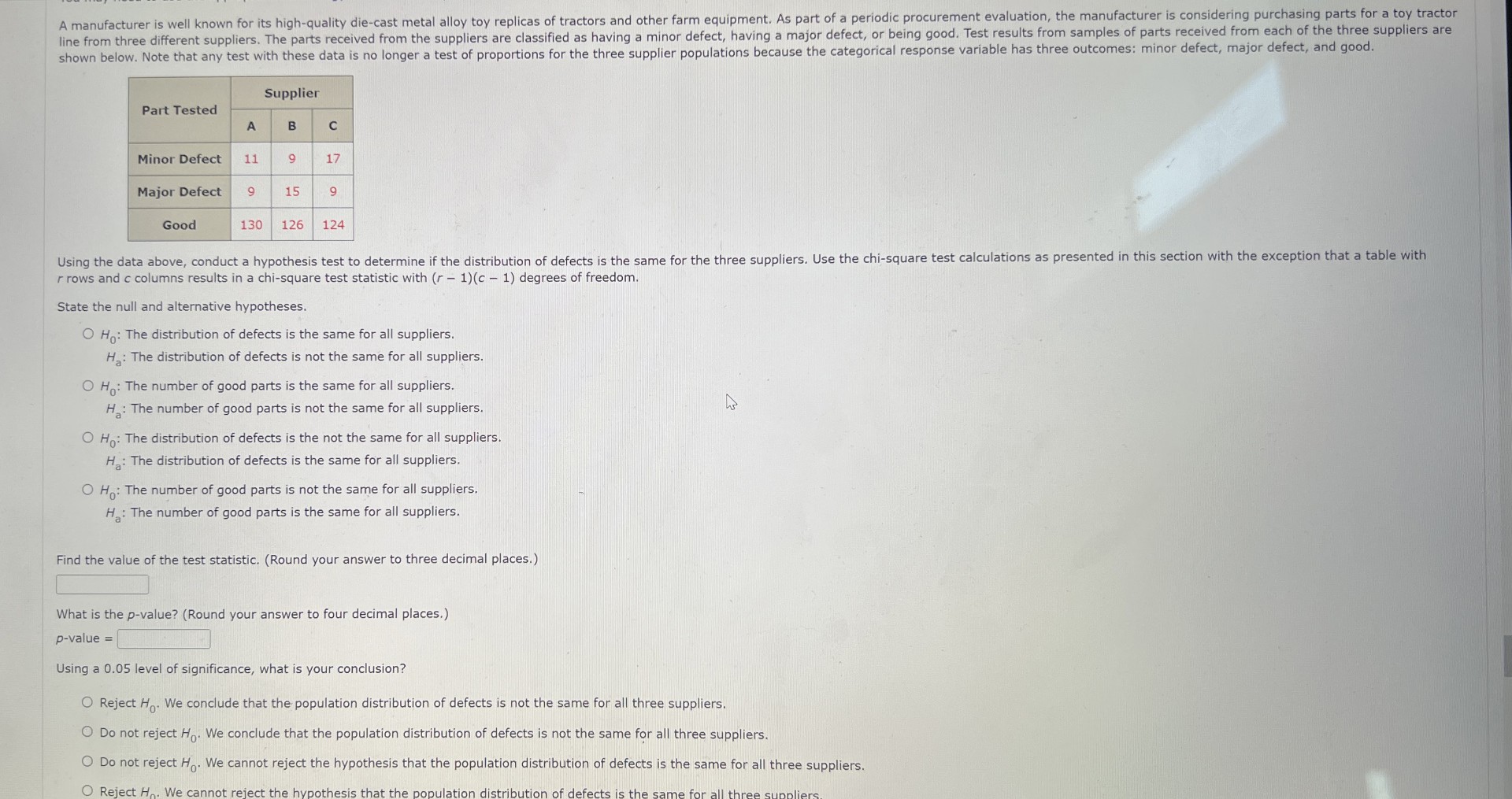
A manufacturer is well known for its high-quality die-cast metal alloy toy replicas of tractors and other farm equipment. As part of a periodic procurement evaluation, the manufacturer is considering purchasing parts for a toy tractor line from three different suppliers. The parts received from the suppliers are classified as having a minor defect, having a major defect, or being good. Test results from samples of parts received from each of the three suppliers are shown below. Note that any test with these data is no longer a test of proportions for the three supplier populations because the categorical response variable has three outcomes: minor defect, major defect, and good. egin{tabular}{|c|c|c|c|} hline multirow{2}{*}{ Part Tested } & multicolumn{3}{|c|}{ Supplier } \ cline { 2 - 4 } & A & B & C \ hline Minor Defect & 11 & 9 & 17 \ hline Major Defect & 9 & 15 & 9 \ hline Good & 130 & 126 & 124 \ hline end{tabular} Using the data above, conduct a hypothesis test to determine if the distribution of defects is the same for the three suppliers. Use the chi-square test calculations as presented in this section with the exception that a table with $r$ rows and $c$ columns results in a chi-square test statistic with $(r-1)(c-1)$ degrees of freedom. State the null and alternative hypotheses. $H_0$: The distribution of defects is the same for all suppliers. $H_a$: The distribution of defects is not the same for all suppliers. $H_0$: The number of good parts is the same for all suppliers. $H_a$: The number of good parts is not the same for all suppliers. $H_0$: The distribution of defects is the not the same for all suppliers. $H_a$: The distribution of defects is the same for all suppliers. $H_0$: The number of good parts is not the same for all suppliers. $H_a$: The number of good parts is the same for all suppliers. Find the value of the test statistic. (Round your answer to three decimal places.) What is the $p$-value? (Round your answer to four decimal places.) $p$-value = Using a 0.05 level of significance, what is your conclusion? Reject $H_0$. We conclude that the population distribution of defects is not the same for all three suppliers. Do not reject $H_0$. We conclude that the population distribution of defects is not the same for all three suppliers. Do not reject $H_0$. We cannot reject the hypothesis that the population distribution of defects is the same for all three suppliers. Reject $H_0$. We cannot reject the hypothesis that the population distribution of defects is the same for all three suppliers.
View Answer
divider
ANSWERED

Ivan Kochetkov verified

Numerade educator

A manufacturer is well known for its high-quality die-cast metal alloy toy replicas of tractors and other farm equipment. As part of a periodic procurement evaluation, the manufacturer is considering purchasing parts for a toy tractor line from three different suppliers. The parts received from the suppliers are classified as having a minor defect, having a major defect, or being good. Test results from samples of parts received from each of the three suppliers are shown below. Note that any test with these data is no longer a test of proportions for the three supplier populations because the categorical response variable has three outcomes: minor defect, major defect, and good. egin{tabular}{|c|c|c|c|} hline multirow{2}{*}{ Part Tested } & multicolumn{3}{|c|}{ Supplier } \ cline { 2 - 4 } & A & B & C \ hline Minor Defect & 11 & 9 & 17 \ hline Major Defect & 9 & 15 & 9 \ hline Good & 130 & 126 & 124 \ hline end{tabular} Using the data above, conduct a hypothesis test to determine if the distribution of defects is the same for the three suppliers. Use the chi-square test calculations as presented in this section with the exception that a table with $r$ rows and $c$ columns results in a chi-square test statistic with $(r - 1)(c - 1)$ degrees of freedom. State the null and alternative hypotheses. $H_0$: The distribution of defects is the same for all suppliers. $H_a$: The distribution of defects is not the same for all suppliers. $H_0$: The number of good parts is the same for all suppliers. $H_a$: The number of good parts is not the same for all suppliers. $H_0$: The distribution of defects is the not the same for all suppliers. $H_a$: The distribution of defects is the same for all suppliers. $H_0$: The number of good parts is not the same for all suppliers. $H_a$: The number of good parts is the same for all suppliers. Find the value of the test statistic. (Round your answer to three decimal places.) What is the $p$-value? (Round your answer to four decimal places.) $p$-value = Using a 0.05 level of significance, what is your conclusion? Reject $H_0$. We conclude that the population distribution of defects is not the same for all three suppliers. Do not reject $H_0$. We conclude that the population distribution of defects is not the same for all three suppliers. Do not reject $H_0$. We cannot reject the hypothesis that the population distribution of defects is the same for all three suppliers. Reject $H_0$. We cannot reject the hypothesis that the population distribution of defects is the same for all three suppliers.

View Answer
divider
ANSWERED

Ivan Kochetkov verified

Numerade educator

A manufacturer is well known for its high-quality die-cast metal alloy toy replicas of tractors and other farm equipment. As part of a periodic procurement evaluation, the manufacturer is considering purchasing parts for a toy tractor line from three different suppliers. The parts received from the suppliers are classified as having a minor defect, having a major defect, or being good. Test results from samples of parts received from each of the three suppliers are shown below. Note that any test with these data is no longer a test of proportions for the three supplier populations because the categorical response variable has three outcomes: minor defect, major defect, and good. egin{tabular}{|c|c|c|c|} hline multirow{2}{*}{ Part Tested } & multicolumn{3}{|c|}{ Supplier } \ cline { 2 - 4 } & A & B & C \ hline Minor Defect & 11 & 9 & 17 \ hline Major Defect & 9 & 15 & 9 \ hline Good & 130 & 126 & 124 \ hline end{tabular} Using the data above, conduct a hypothesis test to determine if the distribution of defects is the same for the three suppliers. Use the chi-square test calculations as presented in this section with the exception that a table with $r$ rows and $c$ columns results in a chi-square test statistic with $(r-1)(c-1)$ degrees of freedom. State the null and alternative hypotheses. ? $H_0$: The distribution of defects is the same for all suppliers. $H_a$: The distribution of defects is not the same for all suppliers. ? $H_0$: The number of good parts is the same for all suppliers. $H_a$: The number of good parts is not the same for all suppliers. ? $H_0$: The distribution of defects is the not the same for all suppliers. $H_a$: The distribution of defects is the same for all suppliers. ? $H_0$: The number of good parts is not the same for all suppliers. $H_a$: The number of good parts is the same for all suppliers. Find the value of the test statistic. (Round your answer to three decimal places.) [ ] What is the $p$-value? (Round your answer to four decimal places.) $p$-value = [ ] Using a 0.05 level of significance, what is your conclusion? ? Reject $H_0$. We conclude that the population distribution of defects is not the same for all three suppliers. ? Do not reject $H_0$. We conclude that the population distribution of defects is not the same for all three suppliers. ? Do not reject $H_0$. We cannot reject the hypothesis that the population distribution of defects is the same for all three suppliers. ? Reject $H_0$. We cannot reject the hypothesis that the population distribution of defects is the same for all three suppliers.

View Answer
divider
ANSWERED

Ivan Kochetkov verified

Numerade educator

In an experiment designed to test the output levels of three different treatments, the following results were obtained: SST = 340, SSTR = 130, n_T = 19. Set up the ANOVA table. (Round your values for MSE and F to two decimal places, and your p-value to four decimal places.) | Source of Variation | Sum of Squares | Degrees of Freedom | Mean Square | F | p-value | | :--- | :--- | :--- | :--- | :--- | :--- | | Treatments | | | | | | | Error | | | | | | | Total | | | | | | Test for any significant difference between the mean output levels of the three treatments. Use ? = 0.05. State the null and alternative hypotheses. ? H_0: Not all the population means are equal. H_a: ?_1 = ?_2 = ?_3 ? H_0: ?_1 = ?_2 = ?_3 H_a: Not all the population means are equal. ? H_0: ?_1 ? ?_2 ? ?_3 H_a: ?_1 = ?_2 = ?_3 ? H_0: At least two of the population means are equal. H_a: At least two of the population means are different. Find the value of the test statistic. (Round your answer to two decimal places.) Find the p-value. (Round your answer to four decimal places.) p-value = State your conclusion. ? Reject H_0. There is sufficient evidence to conclude that the means of the three treatments are not equal. ? Do not reject H_0. There is sufficient evidence to conclude that the means of the three treatments are not equal. ? Reject H_0. There is not sufficient evidence to conclude that the means of the three treatments are not equal. ? Do not reject H_0. There is not sufficient evidence to conclude that the means of the three treatments are not equal.

View Answer
divider
ANSWERED

Willis James verified

Numerade educator

Find the indicated z score. The graph depicts the standard normal distribution with mean 0 and standard deviation 1. The indicated z score is (Round to two decimal places as needed.)

View Answer
divider
ANSWERED

Kirsty Gledhill verified

Numerade educator

A population is known to have a mean of ? = 45. If a researcher predicts that the experimental treatment will produce a decrease in the population mean, then the null hypothesis for a one-tailed test would state a. ? > 45. b. ? ? 45. c. ? < 45. d. X ? 45.

View Answer
divider
INSTANT ANSWER

Consider the following data set: \[ \begin{array}{lllllllll} 32 & 60 & 40 & 34 & 55 & 43 & 76 & 73 & 59 \\ 42 & 32 & 37 & 42 & 55 & 68 & 42 & 77 & 59 \end{array} \] Find the 18th and 88th percentiles for this data. (Hint: Use the chart at page 125.) 18th percentile \( = \) 35.26 \( \square \) 88th percentile \( = \) 75.16 \( \square \)

View Answer
divider